
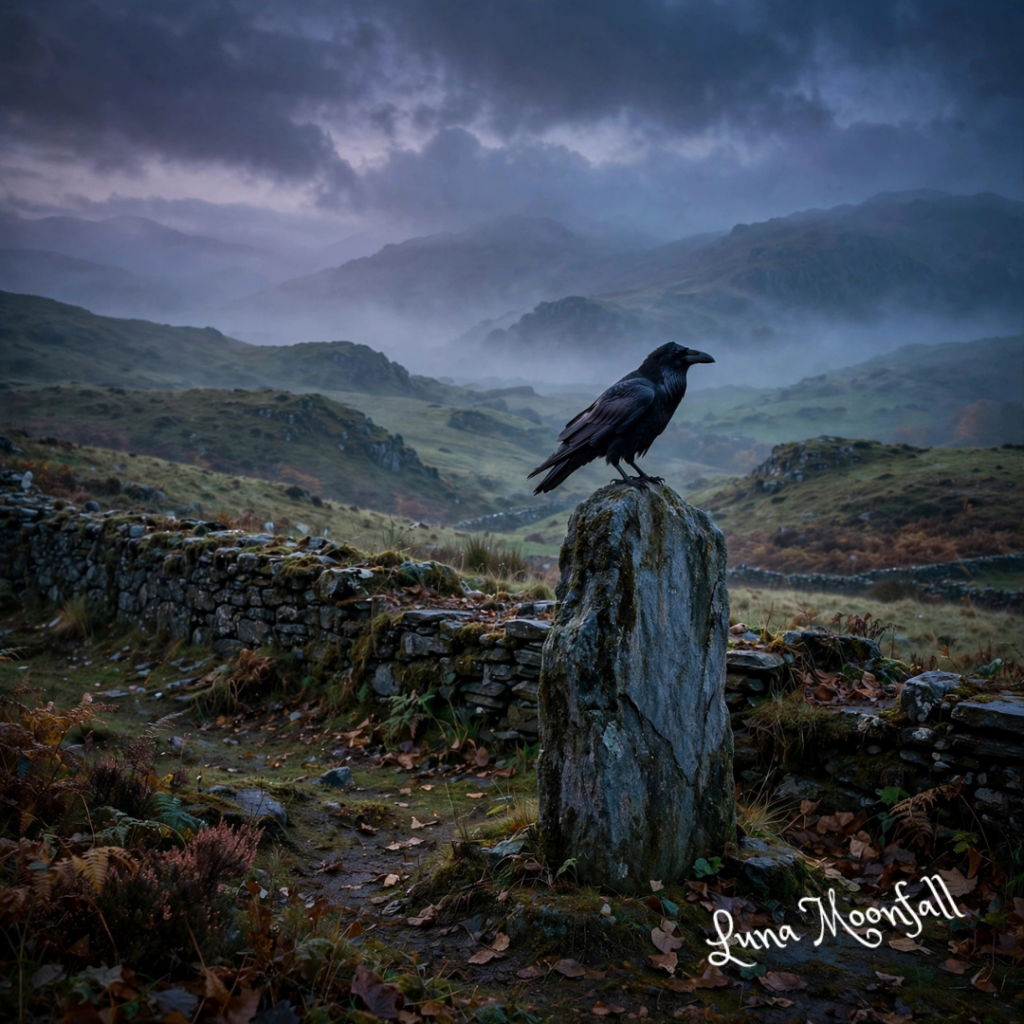
The Morrigan (also spelled Mórrígan or Morrígan) is one of the most fascinating figures in Irish mythology. Her name is roughly pronounced MORE-ree-gun, although pronunciation changed over the history of the Irish language.
She is often described as a goddess of war, but that description only tells part of the story. The Morrigan appears in medieval Irish literature as a supernatural woman associated with battle, prophecy, transformation, cattle, and the fate of warriors and kingdoms. She can be a fierce ally, a dangerous opponent, a shape-shifter, and a prophetic figure whose words carry consequences.
Modern witches have embraced the Morrigan for many of these qualities. She is now commonly associated with personal sovereignty, courage, boundaries, transformation, shadow work, and facing difficult truths.
There is an important distinction, though, between the Morrigan found in Irish mythology and the Morrigan of modern witchcraft. Medieval Irish texts don’t give us a modern devotional handbook, correspondence chart, or step-by-step ritual system. Much of what you’ll find today (Morrigan crystals, altar arrangements, tarot associations, and devotional rituals) belongs to contemporary practice.
That doesn’t make modern practice meaningless. It just helps us understand what comes from the surviving mythology and what has developed since.
So who exactly was the Morrigan? How old is her tradition? Why is she connected with Badb, Macha, and Nemain? And what does it mean if you’re drawn to her today?
Let’s start with the history.
This post may contain affiliate links. If you choose to make a purchase through these links, I may earn a small commission at no additional cost to you. These commissions help support Moonfall Metaphysical and allow me to continue creating free content, guides, and resources for the community.
I only recommend products, books, and tools that align with the spirit of this content and that I believe may genuinely be interesting, useful, or inspiring to readers.
How Old Is the Morrigan?
It’s tempting to give the Morrigan a precise age. You’ll sometimes see claims that she’s thousands of years old, or that her worship can be traced to a particular prehistoric date.
The evidence doesn’t allow us to be that specific.
The Morrigan belongs to the pre-Christian mythological world of Ireland, but the written sources that preserve her stories are medieval. Earlier religious traditions undoubtedly existed before these texts were written down, yet we can’t establish exactly when the figure we now call the Morrigan first emerged.
One early medieval glossary, generally dated to around the eighth century, refers to morrígna in connection with Macha. Later early medieval sources contain additional references, while the fuller stories involving the Morrigan survive in medieval manuscripts.
That gives us an important distinction:
The surviving manuscripts are not the same age as the mythology they preserve.
Irish storytelling existed as an oral tradition long before the surviving manuscripts were produced. Some of the texts that contain Morrigan stories survive only in manuscripts copied centuries after the period in which the stories are set.
A Brief Timeline
| Period | What we can say |
|---|---|
| Pre-Christian Ireland | The religious and mythological traditions underlying the Morrigan belong to Ireland’s pre-Christian past. |
| c. 8th century CE | Early surviving glossary material refers to morrígna and connects Macha with the term. |
| Early medieval period | Additional references to the Morrigan appear in learned and literary material. |
| 11th–12th centuries and later | Major manuscript traditions preserve Irish mythological and heroic stories involving the Morrigan. |
| Medieval Ireland | Stories such as Cath Maige Tuired, Táin Bó Regamna, and Táin Bó Cúailnge preserve important appearances of the Morrigan. |
| Modern Paganism | The Morrigan becomes an important figure in contemporary Pagan and witchcraft practice. |
The dates of the surviving manuscripts vary, and some important stories survive in considerably later copies of earlier material. That is why historians are careful about saying exactly when a particular myth originated.
The safest answer to “How old is the Morrigan?” is therefore this: her mythology belongs to the ancient, pre-Christian Irish tradition, but we cannot give a precise date for her origin. The earliest surviving written evidence is early medieval, while many of the fuller stories were preserved in later medieval manuscripts.
Who Is the Morrigan?
The Morrigan is a supernatural female figure in Irish mythology whose stories connect her with war, battle, prophecy, fate, transformation, sovereignty, and supernatural power.
Her name appears in several forms, including Mórrígan, Morrígan, and Morrigu. The spelling varies depending on the source and period of Irish, so you’ll encounter more than one version when researching her.
The Morrigan appears particularly within the Mythological Cycle and Ulster Cycle, although the medieval Irish literary tradition doesn’t give us one neat, consistent theology explaining exactly who she is.
That’s worth remembering when researching the Morrigan. There isn’t one ancient Irish text that lays out her domains, symbols, personality, and worship practices in the way a modern deity guide might.
Her character emerges through multiple stories, and those stories don’t always present her in exactly the same way.
In Cath Maige Tuired, roughly pronounced “kah MEE-guh TIR-ed,” the Morrigan takes part in the conflict between the Túatha Dé Danann, roughly “TOO-ah-ha day DAH-nan,” and the Fomorians. She strengthens the Túatha Dé before battle and later announces their victory.
In other stories, she appears in relation to the hero Cú Chulainn, roughly pronounced “koo HULL-in.” Their encounters are tangled up with battle, supernatural transformation, injury, and fate.
This is why calling her simply a war goddess can be misleading.
War is certainly part of her mythology. So are prophecy, transformation, cattle, supernatural power, and the consequences of conflict.
The Morrigan in Irish Mythology
Three bodies of material are particularly useful when exploring the Morrigan:
- Cath Maige Tuired — the story of the Second Battle of Mag Tuired
- Táin Bó Regamna — a story from the Ulster Cycle involving Cú Chulainn and the Morrigan
- Táin Bó Cúailnge — roughly pronounced “tawn boh KOO-il-nye”, the great cattle raid of Cooley
Together, these stories show just how difficult it is to reduce the Morrigan to a single role.
The Morrigan in Cath Maige Tuired
Cath Maige Tuired tells the story of the Second Battle of Mag Tuired, a major conflict involving the Túatha Dé Danann and the Fomorians.
The Morrigan appears as an active participant in the events leading up to the battle. She is involved in preparations for the conflict and later strengthens the Túatha Dé to fight fiercely.
Her role is also prophetic.
Near All Hallows, the Dagda encounters a mysterious woman at the River Unshin. The text identifies this woman as the Morrigan. She tells the Dagda that the Fomorians will land at Mag Céidne and describes her own plans for confronting their king, Indech.
The encounter is particularly interesting because it places the Morrigan at the edge of the seasonal turning point associated with Samhain, while also placing her directly within the political and military events that follow.
Later, when the battle begins, the Morrigan strengthens the Túatha Dé and urges them toward the fight. After the battle has been won, she announces the victory and delivers a prophetic speech concerning Ireland’s future.
Here we see several sides of the Morrigan operating at once: she is involved in warfare, she possesses foreknowledge, she influences the course of events, and she speaks about what is still to come.
The Morrigan and Cú Chulainn
The Morrigan’s relationship with Cú Chulainn is very different.
In Táin Bó Regamna, Cú Chulainn encounters a mysterious woman driving a cow. He challenges her, and the confrontation becomes increasingly hostile. The woman reveals supernatural knowledge about a future battle and tells Cú Chulainn that she will appear against him.
The story ends with the woman identified as the Morrigan leaving for the síd of Cruachan.
Her relationship with Cú Chulainn continues in Táin Bó Cúailnge, where she attempts to interfere with him during the cattle raid.
She appears in several forms, including an animal form that the text identifies as a white-red heifer, an eel, and a wolf-like creature. Cú Chulainn fights against these manifestations without initially recognizing that the Morrigan herself is behind them.
The encounters become a strange contest of strength, magic, pride, and fate.
Cú Chulainn is a formidable warrior, but the Morrigan isn’t simply another warrior standing across the battlefield. She operates through supernatural transformation and attempts to alter the circumstances surrounding his combat.
These stories are some of the clearest reasons that the Morrigan became associated with shape-shifting, battle, prophecy, and fate in later interpretations.
The Morrigan as Prophet and Participant
One of the most interesting things about the Morrigan is that she isn’t confined to the role of an observer.
She doesn’t simply predict a battle and wait to see what happens.
In Cath Maige Tuired, she takes part in the conflict itself. She strengthens the Túatha Dé, acts against their enemies, and later announces the victory.
Her prophecy also looks beyond the immediate battle. After the fighting, she speaks about the future of Ireland, shifting the story from the outcome of one war toward the fate of the land itself.
That combination of action and prophecy is one of the most compelling features of her mythology.
It also helps explain why modern practitioners often associate the Morrigan with difficult decisions, transformation, courage, and confronting consequences. Those modern interpretations aren’t identical to the medieval stories, but they grow naturally from themes that are actually present in the mythology.
The Morrigan, Badb, Macha & Nemain
If you’ve researched the Morrigan before, you’ve probably encountered three other names: Badb, Macha, and Nemain.
Badb is roughly pronounced “BAYV,” Macha is approximately “MAKH-ah,” with the ch sounding like the ch in Scottish loch, and Nemain is roughly “NEV-an.”
These names are closely connected with the Morrigan in medieval Irish literature, but exactly how they relate to one another varies between sources.
Badb
Badb is strongly associated with warfare, battle frenzy, prophecy, and death. She can appear in the form of a crow or raven-like bird, and the name is closely connected with the terrifying supernatural aspects of battle.
In medieval Irish literature, Badb isn’t merely a decorative symbol of war. She is an active supernatural figure whose presence can influence the battlefield and its outcome.
The connection between Badb and the Morrigan is one reason modern readers sometimes treat the two names as interchangeable. The medieval material, however, doesn’t always make their identities quite so simple.
Macha
Macha has several different appearances in Irish mythology, and not every character named Macha should automatically be treated as the same figure.
She is associated in different stories with sovereignty, land, horses, warfare, and the supernatural. One of the best-known stories involving Macha tells of a woman forced to race against the king’s horses while heavily pregnant. After winning the race, she curses the men of Ulster to suffer the pain of childbirth when their greatest need arises.
Macha is also particularly important when examining the historical relationship between the Morrigan and the other figures associated with her. An early medieval glossary connects Macha with the term morrígna, the plural of morrígan.
Nemain
Nemain is another supernatural female figure associated with battle and terror.
Her appearances are less prominent in modern discussions of the Morrigan, but medieval texts connect her with the destructive and terrifying aspects of warfare.
That association helps explain why Badb, Macha, and Nemain are often discussed alongside the Morrigan when exploring Irish battle deities.
So, Is the Morrigan a Triple Goddess?
Sort of, but the answer needs some context.
Modern Pagan sources frequently describe the Morrigan as a triple goddess consisting of Badb, Macha, and Nemain. You’ll also find modern interpretations that assign each figure a particular stage of life, personality, or magical function.
That modern framework can be useful for contemporary witchcraft, but it shouldn’t be presented as though medieval Irish mythology gives us a neat Maiden, Mother, and Crone system.
It doesn’t.
The surviving Irish material is more complicated. Different texts use the names differently, and relationships between these figures vary. Some medieval sources identify Badb, Macha, and the Morrigan together, while other traditions give Macha, Badb, and Nemain different roles.
The modern idea of the Morrigan as one goddess expressed through three distinct forms developed from these overlapping traditions. The familiar Maiden/Mother/Crone interpretation is a much more recent Pagan framework.
So when someone asks, “Is the Morrigan a triple goddess?”, the most honest answer is that modern practitioners commonly understand her that way, but the medieval evidence doesn’t give us one definitive triple-goddess doctrine.
That distinction actually makes the mythology more interesting. Instead of forcing every surviving story into one system, we can allow the different traditions to remain different.
Want to go deeper into Irish mythology? A good mythology reference book is worth having nearby when you’re studying the Morrigan’s appearances across different medieval texts.
What Does the Name Morrigan Mean?
The Morrigan name meaning is another subject where you’ll encounter several competing explanations.
The name appears in forms including Mórrígan, Morrígan, and Morrigu. A common interpretation connects the name with Old Irish words meaning “great” and “queen,” leading to the familiar translation “Great Queen.”
You’ll also see the Morrigan translated as the “Phantom Queen.” This interpretation has become extremely popular in modern writing, although the etymology is more complicated than that simple English translation suggests.
There is disagreement among scholars about exactly how the name should be interpreted and how some of its forms developed.
That means it’s better to treat “Great Queen” as a common interpretation rather than an unquestionable translation.
Why Is She Called the Great Queen?
The interpretation of Mórrígan as “Great Queen” fits comfortably with many modern understandings of her as a powerful supernatural figure connected with sovereignty, battle, and the fate of rulers and kingdoms.
There is an important difference between what the name may have meant historically and what the title has come to mean in modern devotional practice, though.
A modern witch may call upon the Morrigan as the Great Queen as an expression of respect, sovereignty, and personal power. That is a valid modern devotional use of the title, but it shouldn’t be confused with evidence for a standardized ancient title or ritual formula.
Morrigan Meaning in Modern Witchcraft
Today, the name Morrigan often carries additional associations with:
- Personal sovereignty
- Strength and courage
- Transformation
- Warrior energy
- Boundaries
- Prophecy and divination
- Death and rebirth
- Facing difficult truths
Some of these themes have strong roots in the mythology, while others are modern devotional interpretations built from the stories.
That distinction doesn’t make modern interpretations less meaningful. It gives you a clearer picture of where the historical mythology ends and contemporary witchcraft begins.
Is the Morrigan a Goddess?
Yes. The Morrigan is commonly described as a goddess or supernatural female deity in Irish mythology, particularly in connection with battle, prophecy, fate, and supernatural power.
But even the word “goddess” doesn’t completely capture what she does in the surviving stories.
The Morrigan isn’t confined to one domain. She can influence battles, appear in prophetic scenes, transform into animals, challenge warriors, and speak about the future of Ireland.
Her mythology also connects her with cattle and the land, particularly through stories involving sovereignty and the great cattle raids that form such an important part of Irish heroic literature.
For that reason, you’ll see the Morrigan described in modern sources as a goddess of:
- War and battle
- Prophecy and fate
- Sovereignty and power
- Transformation
- Death and the consequences of violence
- Cattle and wealth
- Supernatural knowledge
Some of these associations are strongly grounded in medieval mythology, while others have been developed or emphasized by modern Pagan practitioners.
Is the Morrigan a Goddess or a God?
If you’ve searched for “Morrigan god”, you may have encountered conflicting information online.
The Morrigan is a female figure in the surviving Irish mythological material and is commonly described as a goddess. There isn’t a separate male Morrigan who should be treated as her counterpart.
The confusion may come partly from the fact that the mythology doesn’t fit neatly into modern categories of deity. The Morrigan is a supernatural being associated with several overlapping powers rather than a goddess with one narrowly defined job.
In modern witchcraft, the word deity is often used more broadly, so you’ll sometimes see people refer to her simply as a Morrigan deity or Irish deity.
Morrigan Symbols & Associations
The Morrigan has accumulated a large number of symbols in modern witchcraft. Some have strong connections to surviving Irish mythology, while others are contemporary magical correspondences.
Keeping those categories separate makes it easier to understand what we’re actually working with.
Crows and Ravens
The crow or raven is probably the symbol most strongly associated with the Morrigan today.
That association has genuine roots in medieval Irish literature. In The Wooing of Emer, the Morrigan is described in connection with the Battle-Crow, and other Irish texts connect battle and supernatural female figures with birds.
Bird imagery fits the Morrigan’s relationship with warfare, prophecy, death, and the battlefield, which is why the crow or raven has become such a recognizable modern symbol of her.
It’s worth separating that mythology from modern ideas about “seeing a crow means the Morrigan is calling you.” A crow is still a crow. Whether a particular encounter has personal spiritual meaning is something for the practitioner to interpret rather than an established rule of Irish mythology.
Cattle
Cattle may seem like an unusual association for a war goddess, but they are central to Irish mythology.
Cattle represented wealth, status, land, and political power in early Irish society. The great cattle raids that appear throughout the Ulster Cycle weren’t simply stories about livestock. They were conflicts over wealth, prestige, territory, and power.
The Morrigan is connected with cattle in several strands of Irish tradition, including stories involving supernatural cattle and the famous cattle raid literature.
This association gives her mythology a connection to land, wealth, sovereignty, and survival that goes well beyond the battlefield.
The Wolf and the Eel
The Morrigan’s ability to change form is particularly clear in her encounters with Cú Chulainn.
In the Ulster Cycle, she appears in animal forms including an eel and a wolf-like creature when attempting to interfere with the hero.
These aren’t simply symbolic animals assigned to her by modern witches. They actually appear in the mythology.
That makes transformation one of the strongest themes associated with the Morrigan.
Weapons and Battle
Swords, spears, shields, armor, and other imagery associated with warfare are common modern Morrigan symbols.
The connection is straightforward: the Morrigan repeatedly appears within stories of battle and conflict.
For modern practitioners, weapons can also represent the ability to defend yourself, establish boundaries, make difficult choices, and stand your ground.
Those latter interpretations are modern magical symbolism rather than instructions from ancient Irish religion.
Prophecy
Prophecy is another major Morrigan association.
She doesn’t merely appear in stories after events have happened. In Cath Maige Tuired, she predicts the arrival of the Fomorians and later speaks about the future after the battle.
This makes prophecy, divination, foresight, and knowledge of consequences natural themes for modern Morrigan practice.
Sovereignty
Sovereignty is one of the most popular modern Morrigan associations.
In Irish mythology, sovereignty is closely connected with land, rulership, kingship, and legitimate authority. Modern witches have expanded that idea into personal sovereignty: knowing your own worth, protecting your boundaries, making your own decisions, and refusing to surrender your power unnecessarily.
That modern interpretation fits particularly well with the Morrigan’s reputation as a formidable supernatural figure, but personal sovereignty as a modern devotional theme should not be mistaken for a documented ancient Morrigan ritual practice.
Morrigan Symbols at a Glance
| Symbol or Association | Connection to the Morrigan |
|---|---|
| Crow / Raven | Battle, prophecy, death, supernatural power |
| Cattle | Wealth, land, status, sovereignty, mythology |
| Wolf | Appears in the Morrigan’s encounters with Cú Chulainn |
| Eel | Appears in the Morrigan’s attempts to interfere with Cú Chulainn |
| Weapons | War, battle, defense, conflict |
| Prophecy | Fate, foresight, knowledge, consequences |
| Transformation | Shape-shifting and changing forms in mythology |
| Sovereignty | Land, authority, power, and modern personal sovereignty |
How Do You Know If the Morrigan Is Calling You?
People often discover the Morrigan through a persistent feeling that keeps bringing them back to her.
Maybe you read one story about her and can’t stop thinking about it. Maybe you’ve started researching Irish mythology and keep encountering her name. You might have recurring dreams involving crows, battlefields, cattle, storms, or other imagery that reminds you of her.
Or perhaps the attraction has less to do with signs and more to do with what she represents. Themes of sovereignty, courage, boundaries, transformation, and facing uncomfortable truths may suddenly feel particularly relevant to your life.
None of these experiences proves that the Morrigan is contacting you. There isn’t an ancient Irish checklist of signs that tells you when the Morrigan has chosen someone.
Modern practitioners have developed their own ways of interpreting these experiences, and personal symbolism can be meaningful. It is still useful to leave room for ordinary explanations and your own judgment.
Common Experiences Practitioners Associate With the Morrigan
Modern witches sometimes interpret the following experiences as possible signs of a Morrigan connection:
- A persistent interest in the Morrigan or Irish mythology
- Repeated encounters with crows or ravens
- Recurring dreams involving birds, battle, animals, or transformation
- A strong interest in sovereignty, boundaries, or personal power
- Repeatedly encountering the Morrigan’s name in unrelated places
- Feeling particularly drawn to stories involving her conflicts with Cú Chulainn
- Finding yourself returning to her mythology after periods of trying to move on
- Repeated Morrigan imagery appearing during meditation or divination
Some of these experiences can happen because you’ve started paying more attention to something that already interests you. That’s perfectly normal. Once the brain recognizes a particular word, image, or subject as important, you’re more likely to notice it again.
Spiritual interpretation and ordinary pattern recognition don’t have to be enemies. You can remain curious without deciding immediately what an experience means.
If you’re unsure whether your experiences are meaningful, start writing them down.
Keep a Morrigan Journal
Record dreams, recurring symbols, tarot readings, unexpected encounters, emotional reactions, and the circumstances surrounding them. Give yourself enough time to look for actual patterns instead of judging each experience individually.
For example, seeing a crow once while thinking about the Morrigan might be interesting. Seeing the same imagery repeatedly over several weeks, particularly alongside dreams or other experiences that feel personally significant, gives you more material to reflect on.
The journal also creates a record that you can revisit later. Something that feels incredibly significant in the moment may look different after a few months.
Use Divination Carefully
Tarot and oracle cards are popular tools for modern Morrigan devotion. They can be useful for reflection, meditation, and asking yourself better questions.
They are not ancient Irish methods of communicating with the Morrigan. Tarot developed long after the period represented in Irish mythology, and there is no surviving evidence that the Morrigan was historically worshipped through tarot cards.
If you use divination to explore a possible connection, open-ended questions tend to be more useful than repeatedly asking, “Is the Morrigan calling me?”
Try questions such as:
- What am I being asked to confront right now?
- Where am I giving away my personal power?
- What boundary needs more attention?
- What can I learn from the Morrigan’s mythology at this point in my life?
- What should I understand before beginning devotional work?
Learn Before You Commit
If you feel drawn to the Morrigan, spend some time learning her mythology before making major devotional commitments.
Read the stories. Compare different interpretations. Learn about Badb, Macha, and Nemain. Explore the Ulster Cycle. Pay attention to what actually appears in the medieval sources and what comes from modern Pagan practice.
You may find that the historical Morrigan interests you more than devotional practice. You may develop a relationship with her over time. Or you may decide that another deity or mythological tradition fits you better.
All three are perfectly reasonable outcomes.
There is no deadline for figuring it out.
Want to take your journaling further? Lora O’Brien’s The Morrigan, Ireland’s Goddess includes more than 50 exercises and journal prompts alongside its exploration of Morrigan mythology and modern devotional practice. It’s a useful next step for readers who want to study the Morrigan while keeping track of their own thoughts and experiences.
How to Work With the Morrigan
There is no surviving ancient Irish handbook explaining how to worship or work with the Morrigan. The devotional practices you’ll find in modern witchcraft have developed from mythology, personal experience, contemporary Pagan traditions, and individual interpretation.
That leaves you with quite a bit of freedom.
Working with the Morrigan can be as simple as studying her mythology and reflecting on what her stories bring up for you. It can also become a more formal devotional practice involving an altar, offerings, prayer, meditation, divination, or seasonal rituals.
Start With Her Stories
Before building a devotional practice around the Morrigan, spend some time with the mythology itself.
Read the stories involving her appearances in Cath Maige Tuired, Táin Bó Regamna, and Táin Bó Cúailnge. Pay attention to what she actually does rather than relying entirely on modern descriptions of her.
You’ll find a figure who is considerably more complicated than a generic “war goddess.” She predicts events, participates in battles, changes form, challenges warriors, interacts with cattle, and speaks about the future of Ireland.
Those stories give you a much stronger foundation for devotional work than a list of internet correspondences ever could.
Create a Simple Devotional Space
A dedicated altar can be helpful if you enjoy physical reminders of your spiritual practice.
You might use a small table, shelf, or section of an existing altar. A crow or raven image, candle, natural object, journal, or other symbol connected with the Morrigan can give the space a clear focus.
You don’t need an elaborate setup. The meaning you attach to the space matters more than how much you put on it.
For ideas, see the Morrigan Altar Ideas section below.
Prayer and Devotion
Prayer is another straightforward way to develop a devotional relationship.
Your prayers can be formal or conversational. You might speak before an altar, write in a journal, or simply take a few quiet minutes to acknowledge the Morrigan and reflect on her mythology.
A modern devotional prayer might sound something like this:
Morrigan, Great Queen, I honor the stories in which you appear and the strength they have carried through generations. Help me face what must be faced, release what has ended, and stand firmly in my own sovereignty.
This is a modern devotional prayer, not a surviving prayer from ancient Ireland.
Meditation and Visualization
Some modern practitioners use meditation or visualization when working with the Morrigan.
You might visualize yourself standing on a battlefield, walking through a dark forest, meeting a crow or raven, or simply sitting quietly with one of her stories in mind.
These are modern spiritual techniques. There is no evidence that ancient Irish worshippers used these exact methods with the Morrigan.
That distinction doesn’t prevent you from finding them meaningful. It simply keeps the historical and modern layers of the practice clear.
Shadow Work
The Morrigan’s mythology naturally lends itself to reflection on difficult subjects.
Her stories involve conflict, death, pride, consequences, power, fear, and transformation. Modern practitioners sometimes use those themes as a starting point for shadow work.
You might explore questions such as:
- Where am I ignoring something I already know?
- Where have I surrendered my own authority?
- Which boundaries need strengthening?
- What am I afraid to confront?
- What part of my life has reached its natural ending?
- Where could I act with greater courage?
The goal isn’t to manufacture a dramatic spiritual experience. Sometimes the most useful devotional work is simply being honest with yourself.
Acts of Sovereignty
Modern Morrigan practice often places a strong emphasis on sovereignty.
That can mean making decisions for yourself, setting boundaries, leaving situations that are harmful, speaking honestly, taking responsibility for your choices, or reclaiming parts of your life that you’ve handed over to someone else.
These aren’t ancient Morrigan rituals. They’re modern ways of applying themes associated with her mythology to everyday life.
Sometimes devotional work looks less like lighting a candle and more like finally saying, “No.”
Divination
Tarot, oracle cards, runes, pendulums, and other forms of divination are common in contemporary witchcraft.
You can use them to reflect on questions surrounding courage, transformation, boundaries, decisions, and personal sovereignty while keeping the Morrigan’s mythology in mind.
Tarot and similar tools are modern additions to Morrigan practice, so it’s best to think of them as contemporary devotional tools rather than historical Irish traditions.
You’ll find a dedicated Morrigan Tarot & Divination section later in this guide.
Seasonal Devotion
Samhain is an especially interesting time to explore the Morrigan because Cath Maige Tuired explicitly places her encounter with the Dagda around All Hallows.
Modern practitioners may choose Samhain as a time for Morrigan devotion, reflection, divination, ancestor work, or rituals focused on endings and transformation.
Again, a modern Samhain ritual should not be presented as an unchanged ancient Morrigan ceremony. What we can do is take inspiration from the surviving mythology and build a meaningful contemporary practice around it.
Using an Obsidian Scrying Mirror
If you want to explore a more traditional style of scrying alongside tarot or oracle cards, a black obsidian scrying mirror can make a fitting addition to a Morrigan altar.
In modern magical practice, obsidian is often associated with protection, grounding, shadow work, and looking beneath the surface… associations that fit naturally with the reflective work many people bring to Morrigan devotion.
A scrying mirror can be used during quiet meditation, especially when you’re working with questions about change, personal boundaries, courage, or what you may be avoiding. Keep the room dim, place the mirror where you can look into its dark surface without straining your eyes, and allow images, impressions, or thoughts to arise without forcing them.
Want to try scrying? A black obsidian scrying mirror can be used as a dedicated divination tool on a Morrigan altar or alongside your tarot and oracle practice.
Let Your Practice Develop Naturally
You don’t have to decide immediately what your relationship with the Morrigan is going to look like.
Start with learning. Spend time with the stories. Keep a journal. Try a prayer. Sit with a question. Make an offering if that feels appropriate. Notice what changes over time.
A devotional practice that grows from genuine curiosity and attention will usually feel much more meaningful than one assembled from a checklist of correspondences.
Morrigan Altar Ideas
A Morrigan altar can be elaborate or incredibly simple. There is no single historically documented altar arrangement that every practitioner needs to recreate.
Modern Morrigan altars often bring together imagery associated with her mythology alongside objects that represent what the practitioner is currently working on.
If you’re creating one for the first time, start with a few meaningful pieces rather than trying to collect every possible correspondence.
What to Put on a Morrigan Altar
- Crow or raven imagery: A statue, artwork, feather you have legally and ethically obtained, or other bird imagery can represent one of the strongest modern symbols associated with the Morrigan.
- A candle: Black, red, deep blue, or purple candles are common modern choices. Select a color based on the intention behind your work rather than following a rigid rule.
- A bowl of water: Water can serve as a simple offering or as a reminder of the rivers, landscapes, and changing boundaries that appear throughout Irish mythology.
- Natural objects: Stones, fallen leaves, acorns, branches, or other naturally shed materials can bring an earthy quality to the altar.
- Cattle imagery: A small bull or cow figure can acknowledge the important role cattle play throughout Irish mythology and in stories connected with the Morrigan.
- Weapons or warrior imagery: A miniature sword, spear, shield, or other symbolic object can represent courage, defense, strength, and confrontation.
- A journal: Use it to record dreams, prayers, divination readings, experiences, and reflections on the mythology.
- Divination tools: Tarot or oracle cards can be included if they are part of your modern practice.
Morrigan Altar Colors
There are no universally established ancient Irish colors for the Morrigan. Modern practitioners commonly gravitate toward darker shades that reflect themes associated with her mythology.
| Color | Modern Association |
|---|---|
| Black | Protection, mystery, death, transformation, shadow work |
| Red | Blood, battle, courage, strength, vitality |
| Deep Blue | Depth, mystery, intuition, prophecy |
| Purple | Power, sovereignty, magic, transformation |
Think of these as modern magical correspondences, not ancient Irish rules. If another color feels more appropriate to your practice, use it.
A Simple Morrigan Altar
If you prefer a minimalist altar, try starting with just four things:
- A candle
- A crow or raven image
- A bowl of water
- A journal
Light the candle when you want to spend time in prayer, meditation, study, or reflection. Write down anything that comes up afterward.
Over time, you can add objects that have personal meaning to your relationship with the Morrigan.
Morrigan Offerings
Offerings are a common part of modern deity work, but there is no surviving ancient list of offerings specifically prescribed for the Morrigan.
That means modern practitioners have developed their own offerings based on mythology, Irish cultural traditions, seasonal foods, and personal devotional relationships.
Common Modern Morrigan Offerings
- Water: A simple and accessible offering that can be refreshed regularly.
- Bread or oats: Simple foods that fit the broader agricultural world of historic Ireland.
- Apples and berries: Seasonal fruit can work particularly well for autumn devotional practice.
- Honey: A traditional food that can be offered in small quantities.
- Meat or dairy: These may be used by practitioners who are comfortable incorporating animal products into their practice.
- Flowers or seasonal plants: Fresh or naturally shed plant material can be offered according to the season.
- Poetry or writing: Creating something in her honor can become a meaningful modern devotional act.
- Acts of courage: Some practitioners dedicate an action to the Morrigan, particularly one involving personal boundaries, courage, or sovereignty.
Food and drink offerings don’t need to sit on an altar indefinitely. Remove anything that will spoil, and dispose of offerings respectfully according to your circumstances.
Offerings Inspired by Irish Mythology
Cattle are particularly significant throughout Irish mythology, including stories involving the Morrigan. Because of that, some modern practitioners choose cattle-related imagery or dairy offerings as symbolic acknowledgments of her mythology.
That doesn’t mean there is evidence that ancient Irish worshippers specifically left a bowl of milk for the Morrigan. It is a modern interpretation based on the importance of cattle within the stories and culture represented by the mythology.
Offering Actions Instead of Objects
An offering doesn’t have to be something you buy.
You could spend an evening reading one of the traditional stories associated with the Morrigan. You could write a poem, create artwork, clean your devotional space, make a difficult decision you’ve been avoiding, or take an action that strengthens an important personal boundary.
For a deity associated in modern practice with sovereignty and courage, an action can sometimes carry more personal meaning than an expensive altar item.
A Simple Morrigan Offering Prayer
Morrigan, I offer this in recognition of the stories, strength, and wisdom associated with you. May I have the courage to face what lies before me, the clarity to know what must change, and the strength to stand in my own sovereignty.
This is a modern devotional prayer written for contemporary practice, not an ancient Irish prayer.
Morrigan Crystals, Herbs & Correspondences
You’ll find long lists of Morrigan crystals, herbs, colors, animals, and other magical correspondences online. Most of these lists come from modern witchcraft rather than surviving Irish religious texts.
There is no ancient Irish source giving us a standardized list of crystals and herbs belonging to the Morrigan. Modern practitioners have developed these associations by drawing from her mythology, traditional magical symbolism, and their own devotional experiences.
That makes them useful tools for contemporary witchcraft, as long as we don’t mistake modern correspondences for historical fact.
Morrigan Crystals
Dark, earthy, and red stones are particularly popular in modern Morrigan practice. The following associations are contemporary magical interpretations:
| Crystal | Modern Magical Association |
|---|---|
| Obsidian | Protection, boundaries, shadow work, transformation |
| Garnet | Courage, strength, vitality, passion |
| Bloodstone | Resilience, courage, physical strength, determination |
| Smoky Quartz | Grounding, protection, release, stability |
| Black Tourmaline | Protection, grounding, boundaries |
You can place a stone on your altar, carry one during meditation, or simply use it as a physical reminder of the quality you’re trying to cultivate.
Morrigan Herbs
Herbal correspondences are also primarily modern. Some herbs fit themes commonly associated with the Morrigan, such as protection, courage, dreams, divination, remembrance, and strength.
| Herb or Plant | Modern Magical Association |
|---|---|
| Mugwort | Dreams, intuition, divination, psychic work |
| Rosemary | Protection, remembrance, purification |
| Yarrow | Courage, boundaries, protection |
| Thyme | Strength, courage, protection |
| Bay Leaf | Victory, wishes, success, intention |
| Oak | Strength, endurance, protection, sovereignty |
These are modern witchcraft correspondences rather than a documented list of plants sacred specifically to the Morrigan.
If you’re interested in incorporating herbs into your practice, my Herbs in Witchcraft guide goes deeper into magical herbalism, correspondences, and practical uses.
Morrigan Colors
Modern practitioners commonly associate the Morrigan with dark, dramatic colors that reflect themes of warfare, mystery, transformation, and power.
| Color | Modern Association |
|---|---|
| Black | Protection, mystery, endings, transformation |
| Red | Blood, battle, courage, vitality |
| Deep Purple | Power, magic, sovereignty |
| Dark Blue | Prophecy, mystery, intuition, depth |
Morrigan Animals
Animal symbolism has a much stronger connection to the mythology itself than many of the crystal correspondences do.
- Crow or raven: Battle, prophecy, death, supernatural power
- Wolf: One of the animal forms associated with the Morrigan in her encounters with Cú Chulainn
- Eel: Another form she takes during her conflict with Cú Chulainn
- Cattle: Wealth, land, status, conflict, and the wider mythology of cattle raids
The crow or raven is particularly prominent in modern Morrigan devotion, while the wolf and eel have a more specific connection to her mythological encounters.
Morrigan Magical Correspondences
| Category | Modern Correspondences |
|---|---|
| Animals | Crow, raven, wolf, eel, cattle |
| Colors | Black, red, deep purple, dark blue |
| Crystals | Obsidian, garnet, bloodstone, smoky quartz, black tourmaline |
| Herbs | Mugwort, rosemary, yarrow, thyme, bay, oak |
| Themes | War, courage, prophecy, sovereignty, transformation, boundaries |
| Tools | Tarot, oracle cards, journal, candles, altar objects |
| Season | Samhain |
Again, this table is intended as a modern witchcraft reference. It isn’t a reconstruction of an ancient Irish religious system.
Using Morrigan Correspondences in Your Practice
You can use these correspondences in a number of ways.
Choose an herb or crystal for your altar. Light a candle in a color that matches your intention. Carry a stone while working on boundaries or courage. Add raven imagery to a devotional space. Use a journal to record dreams and divination.
You can also create your own correspondences based on the mythology.
For example, if a particular story about the Morrigan makes you think about resilience, you might choose a stone that you personally associate with strength. If her prophetic speeches are what draw you in, you might choose mugwort or another herb that you already use for divination.
A correspondence becomes more useful when you understand why you’re using it.
A Note About Herbal Safety
Magical does not automatically mean harmless. Some plants used in witchcraft can be toxic, interact with medications, cause skin reactions, or become dangerous when consumed.
Research an herb thoroughly before ingesting it or applying it to your skin. When in doubt, keep potentially hazardous plants strictly for symbolic or altar use.
For a broader look at magical herbs and their traditional witchcraft associations, visit the Herbs in Witchcraft guide.
Morrigan Tarot & Divination
Tarot can be a useful modern tool for exploring the themes associated with the Morrigan, particularly courage, transformation, consequences, power, uncertainty, and personal sovereignty.
There is no evidence that tarot was used in ancient Irish devotion to the Morrigan. Tarot originated centuries after the period represented by the mythology, so any Morrigan tarot practice is a modern form of divination and devotional work.
That doesn’t make it less useful. Tarot gives you a structured way to reflect on questions that naturally arise when studying the Morrigan and her stories.
Call of the Morrigan Oracle is a particularly fitting choice for readers who want a divination deck created specifically around the Morrigan and Irish mythology. The 45-card deck comes with a guidebook and can be used alongside a traditional tarot deck for devotional or reflective readings.
Tarot Cards Associated With the Morrigan
There isn’t one officially designated “Morrigan tarot card.” Different readers may associate different cards with her depending on the deck, tradition, and personal interpretation.
These are some of the cards that fit particularly well with themes found in her mythology:
| Tarot Card | Why It Fits |
|---|---|
| Death | Transformation, endings, change, and the transition from one state to another |
| The Tower | Sudden upheaval, destruction of what can no longer stand, revelation |
| Justice | Consequences, accountability, truth, and the results of choices |
| The Emperor | Authority, power, leadership, structure, and sovereignty |
| The Chariot | Determination, willpower, conflict, control, and forward movement |
| Strength | Courage, resilience, self-control, and inner power |
| The Moon | Dreams, uncertainty, intuition, mystery, and the unseen |
| The Hierophant | Tradition, spiritual learning, mythology, and relationship with established practice |
Of these, Death, The Tower, Justice, and The Moon can be particularly interesting for Morrigan-focused readings. Their meanings overlap with several of the themes found throughout her mythology without reducing her to a single personality trait.
Using Tarot to Explore the Morrigan
If you’re wondering whether to begin working with the Morrigan, tarot can be used as a reflective tool rather than a way to demand certainty.
Instead of repeatedly asking whether a particular crow, dream, or coincidence was “really” a message, ask questions that give you something useful to work with.
For example:
- What should I understand about the Morrigan’s mythology?
- What part of her story am I being drawn toward?
- What personal boundary needs my attention?
- What am I avoiding confronting?
- What strength do I need to develop?
Keep a record of your readings so you can look back at them later. Tarot becomes much more useful when you compare the reading with what actually happens in your life instead of treating every card as a prediction.
A 5-Card Morrigan Tarot Spread
This spread is designed around themes commonly associated with the Morrigan: confrontation, sovereignty, endings, courage, and transformation.
- What am I being called to confront?
Look honestly at the situation, fear, decision, or truth you’ve been avoiding. - Where am I giving away my sovereignty?
Consider where another person, situation, habit, or fear has too much control over your choices. - What needs to end?
This can represent a habit, relationship dynamic, belief, expectation, or situation that has reached its conclusion. - What strength do I need to claim?
Look for the quality or resource that will help you move forward. - What can emerge from this transformation?
The final card looks beyond the immediate difficulty toward what may become possible afterward.
A One-Card Morrigan Reading
If you don’t want to do a full spread, pull one card and ask:
What does the Morrigan’s mythology have to teach me about where I am right now?
Then interpret the card in the context of the mythology you’ve been studying.
For example, pulling the Justice card might prompt you to examine consequences and personal accountability. The Death card could encourage you to consider what has reached its natural ending. The Strength card might point toward courage that doesn’t require aggression.
The purpose isn’t to force every tarot card into a Morrigan interpretation. Let the card speak for itself and then consider how its message intersects with the themes you’re exploring.
Choosing a Tarot Deck for Morrigan Work
You don’t need a special “Morrigan tarot deck” to work with her.
A traditional Rider-Waite-Smith-inspired deck can work beautifully because the imagery is familiar and the card meanings are well established. A darker or mythology-inspired deck may appeal to you aesthetically, but the most useful deck is ultimately the one you enjoy reading.
If you’re building a Morrigan devotional practice, keeping your tarot deck near your altar can create a dedicated space for readings and reflection.
The Morrigan & Samhain
The Morrigan has a particularly interesting connection with Samhain, the ancient Irish seasonal festival marking the beginning of winter.
Unlike many modern Morrigan-Samhain associations, this connection has a basis in medieval Irish literature.
In Cath Maige Tuired (roughly pronounced “kah MEE-guh TIR-ed”), the Morrigan meets the Dagda near a body of water around All Hallows, the Christian-era name associated with the seasonal festival traditionally connected with Samhain.
The encounter takes place shortly before the conflict with the Fomorians. The Morrigan tells the Dagda that the Fomorians are preparing to come to Ireland and describes part of her own plan for the coming battle.
She later appears in the story again after the battle, announcing the victory and delivering a prophecy concerning the future of Ireland.
That gives us a fascinating combination of themes: Samhain, prophecy, warfare, fate, transformation, and the future of the land.
Why Is the Morrigan Associated With Samhain?
Modern witches often connect the Morrigan with Samhain because of this episode in Cath Maige Tuired.
Samhain was a major seasonal turning point in the traditional Irish calendar. It marked the transition into winter and was associated with a time when the boundary between the ordinary world and the supernatural was understood to be particularly open.
The Morrigan’s appearance around All Hallows fits naturally into the atmosphere of the story: she arrives at a significant seasonal threshold, speaks about an approaching conflict, and later speaks of what is yet to come.
Modern Morrigan devotion has built upon these themes, making Samhain a popular time for rituals involving prophecy, reflection, transformation, endings, and personal sovereignty.
Was Samhain the Morrigan’s Festival?
Not exactly.
There is no surviving evidence establishing Samhain as a festival specifically dedicated to the Morrigan. Samhain was a broader seasonal festival within traditional Irish culture, and the Morrigan appears in one important literary episode connected with the time of All Hallows.
That’s different from saying that ancient Irish people celebrated “the Morrigan’s festival” at Samhain.
The modern connection is still meaningful. It just has a much stronger foundation when we describe it accurately.
The Morrigan, Prophecy & the Turning of the Year
One reason the Morrigan works so well within modern Samhain practice is her connection with prophecy.
Samhain represents a turning point: the end of the harvest season, the beginning of winter, and a symbolic movement from one part of the year into another.
The Morrigan’s mythology repeatedly places her at moments of conflict and change. She knows things others do not, interferes with the course of battles, and speaks about what is still to come.
For a modern witch, that creates a natural framework for Samhain divination.
You might use the season to ask:
- What needs to come to an end?
- What have I learned from the past year?
- Where do I need stronger boundaries?
- What am I carrying into the next season that no longer serves me?
- What truth have I been avoiding?
- Where do I need courage?
- What do I want to build during the coming winter?
A Morrigan-Inspired Samhain Altar
If you’d like to bring the Morrigan into your Samhain altar, you can combine seasonal objects with symbols associated with her mythology.
- A black, red, deep blue, or purple candle
- A crow or raven image
- Autumn leaves or other naturally fallen seasonal materials
- A bowl of water
- An offering of seasonal food
- A journal for reflection
- A tarot or oracle deck for divination
- A stone associated with protection, courage, or transformation
There is no requirement to use all of these. A candle and a small seasonal offering can be enough to create a meaningful devotional moment.
Morrigan Samhain Reflection
Before beginning a ritual, take a few minutes to reflect on the year behind you.
Think about what changed. Consider the battles you fought, the decisions you made, the boundaries you established, and the things you lost or chose to leave behind.
Then ask yourself what you want to carry forward.
The Morrigan’s mythology doesn’t offer a particularly gentle picture of transformation. Change can involve conflict, endings, consequences, and uncomfortable truths.
That makes her an interesting figure to contemplate at Samhain, when the season itself invites reflection on endings and beginnings.
A Modern Morrigan Samhain Practice
You can create a simple Samhain devotional practice without trying to recreate an ancient Irish ceremony.
- Prepare your space. Place a candle, seasonal object, and a symbol of the Morrigan on your altar.
- Light the candle. Take a few quiet moments to settle yourself and focus on the transition into the darker half of the year.
- Make an offering. Offer water, seasonal food, flowers, or another appropriate devotional gift.
- Read a piece of the mythology. Choose a passage involving the Morrigan, particularly her appearance in Cath Maige Tuired.
- Reflect. Consider what has ended, what needs to change, and where you need greater courage or sovereignty.
- Use divination. Pull one tarot or oracle card with a question focused on the coming season.
- Close the ritual. Thank the Morrigan, extinguish the candle safely, and record anything meaningful in your journal.
This is a modern Morrigan Samhain ritual inspired by the surviving mythology. It isn’t a reconstruction of an ancient Irish ceremony.
Working With the Morrigan During Samhain
Samhain doesn’t have to become a dramatic ritual occasion. You could spend the evening reading Irish mythology, tending your altar, making an offering, pulling a single tarot card, or writing about what you’re ready to leave behind.
The historical connection gives us a fascinating starting point. What you build from it belongs to modern practice.
Frequently Asked Questions About the Morrigan
Who is the Morrigan?
The Morrigan is a powerful female supernatural figure in Irish mythology associated with warfare, prophecy, fate, transformation, and supernatural power. She appears in several medieval Irish texts, including Cath Maige Tuired, Táin Bó Regamna, and Táin Bó Cúailnge.
Is the Morrigan a goddess?
Yes. The Morrigan is commonly described as a goddess or female deity in Irish mythology. Her mythology doesn’t limit her to one specific domain, however. Her stories connect her with battle, prophecy, fate, sovereignty, transformation, cattle, and the supernatural.
What is the Morrigan the goddess of?
The Morrigan is most strongly associated with warfare, battle, prophecy, fate, and supernatural power. Modern Pagan practice also commonly connects her with personal sovereignty, courage, boundaries, transformation, and shadow work.
What does Morrigan mean?
The meaning of the name Morrigan is debated. A common interpretation connects Mórrígan with the Old Irish words for “great” and “queen,” giving the familiar translation “Great Queen.” “Phantom Queen” is another popular modern translation, although the etymology is more complicated than that phrase suggests.
Is the Morrigan a triple goddess?
Modern Paganism commonly describes the Morrigan as a triple goddess associated with Badb, Macha, and Nemain. Medieval Irish sources do connect these figures in various ways, but they don’t provide one consistent Maiden/Mother/Crone-style system. The familiar modern triple-goddess interpretation is a later Pagan framework built from older Irish traditions.
What animals are associated with the Morrigan?
The crow or raven is the animal most strongly associated with the Morrigan in modern practice and has genuine roots in Irish mythology. The Morrigan also appears in animal forms including an eel and a wolf-like creature during her encounters with Cú Chulainn. Cattle are another important association because of their prominent role in Irish mythology and stories involving the Morrigan.
Is the Morrigan associated with Samhain?
Yes, there is a significant literary connection. In Cath Maige Tuired, the Morrigan meets the Dagda around All Hallows, the period associated with Samhain, shortly before the battle with the Fomorians. She later announces the victory and speaks prophetically about the future of Ireland. Modern Morrigan devotion has developed a strong Samhain connection from these themes.
Is the Morrigan a goddess or a god?
The Morrigan is a female supernatural figure in the surviving Irish mythological tradition and is commonly described as a goddess. There isn’t a separate male Morrigan who serves as her counterpart.
How do I know if the Morrigan is calling me?
There isn’t an ancient checklist of signs that proves the Morrigan is contacting someone. Modern practitioners sometimes interpret recurring dreams, crow or raven imagery, repeated encounters with her name, or a persistent attraction to her mythology as possible signs. Keeping a journal and looking for patterns over time can be more useful than interpreting every coincidence individually.
How can I work with the Morrigan?
Modern Morrigan practice can include studying her mythology, prayer, meditation, maintaining a devotional altar, making offerings, journaling, shadow work, and using tarot or other forms of divination. There is no surviving ancient instruction manual for Morrigan devotion, so these practices belong to contemporary Paganism.
What can I offer the Morrigan?
Modern practitioners may offer water, seasonal foods, flowers, poetry, artwork, or dedicated devotional time. Some also dedicate acts of courage, boundary-setting, or personal growth to the Morrigan. There is no surviving ancient list of required Morrigan offerings.
What crystals are associated with the Morrigan?
Modern witches commonly associate the Morrigan with dark or red stones such as obsidian, garnet, bloodstone, smoky quartz, and black tourmaline. These are contemporary magical correspondences rather than documented ancient Irish associations.
What herbs are associated with the Morrigan?
Modern Morrigan correspondences often include mugwort, rosemary, yarrow, thyme, bay leaf, and oak. These associations are based on modern magical symbolism involving dreams, divination, protection, courage, strength, and sovereignty rather than a surviving ancient Morrigan herb list.
What tarot card represents the Morrigan?
There is no single tarot card historically associated with the Morrigan. Modern readers often connect her with cards such as Death, The Tower, Justice, The Moon, Strength, The Emperor, and The Chariot because of their themes of transformation, consequences, mystery, courage, power, and conflict.
How old is the Morrigan?
The mythology of the Morrigan belongs to an Irish tradition that predates Christianity, but we cannot give an exact date for when the tradition began. The earliest surviving written evidence for the Morrigan comes from the early medieval period, with major stories preserved in medieval manuscripts.
Is the Morrigan Celtic or Irish?
The Morrigan is specifically rooted in Irish mythology. “Celtic goddess” is a broader modern search term that can refer to deities from several Celtic-speaking cultures, but the surviving mythology of the Morrigan belongs to the Irish tradition.
Working With the Morrigan in Modern Witchcraft
The Morrigan is one of the most compelling figures in Irish mythology, but understanding her means looking beyond the simplified versions that often circulate in modern witchcraft.
Her surviving stories place her in the middle of battles, prophecies, supernatural encounters, and moments of major change. She can appear as a mysterious woman, a battle figure, or in animal form, and her connections with Badb, Macha, and Nemain have been interpreted in different ways across time.
Modern witches have built new devotional practices around these older stories, bringing the Morrigan into work involving sovereignty, courage, boundaries, transformation, shadow work, divination, and personal growth.
There is plenty of room for that modern practice. The key is knowing where the historical mythology ends and contemporary witchcraft begins.
You don’t have to recreate an imaginary ancient ritual or follow a rigid list of correspondences. Start with the stories. Read them. Question them. Sit with the parts that catch your attention.
From there, your own practice can develop naturally through prayer, offerings, divination, seasonal rituals, study, and the choices you make in your everyday life.
For many modern practitioners, that may be the most meaningful lesson of all: sovereignty isn’t something another person can hand you. It is something you learn to claim for yourself.
And sometimes that means having the courage to face what you’ve been avoiding.
More Witchcraft & Seasonal Guides
- Samhain: History, Traditions, Rituals & Celebration Ideas
- Herbs in Witchcraft: Magical Herbs & Their Uses