
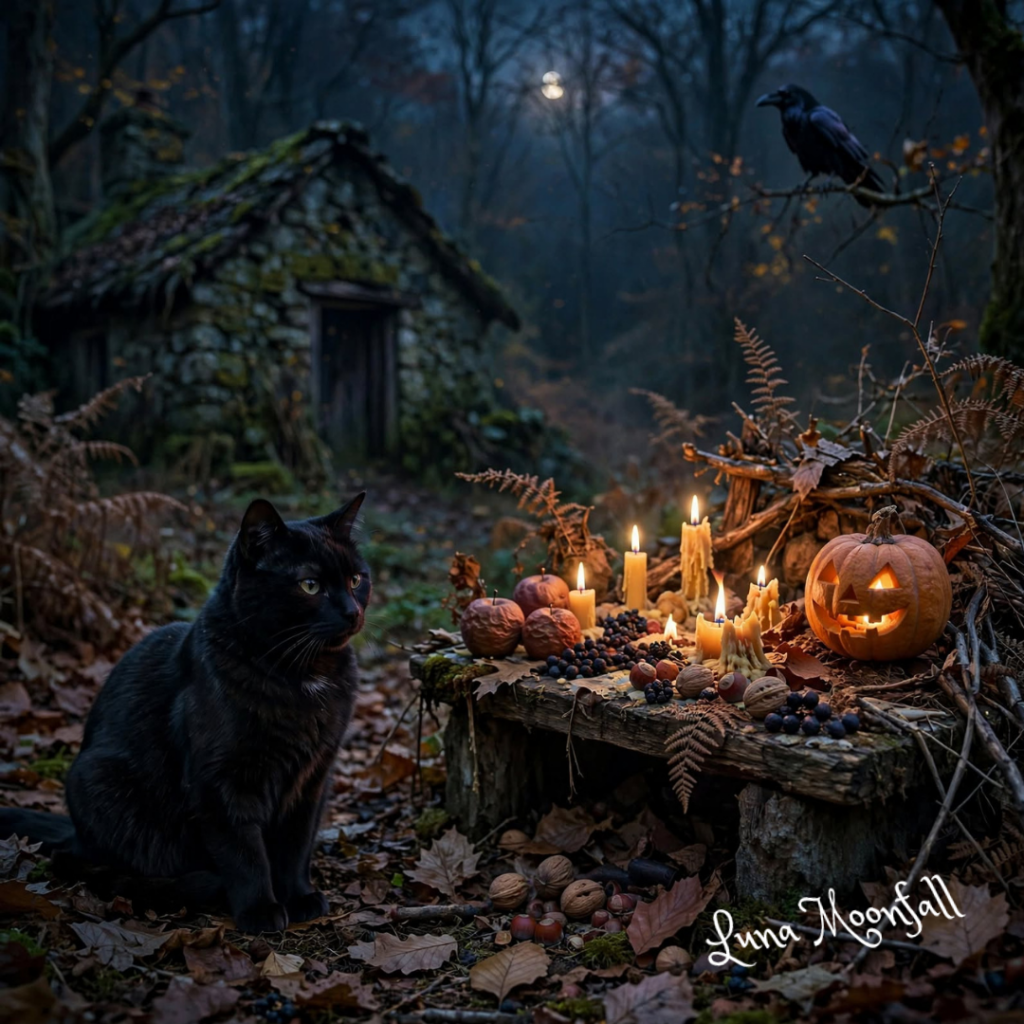
As autumn settles in and the last harvests are gathered, the Wheel of the Year turns toward Samhain beginning October 31st 2026. Samhain 2026 is traditionally observed from the evening of October 31 into November 1, 2026. The days are getting shorter, the evenings have a little more bite to them, and the natural world is beginning its slow retreat into winter.
Samhain is a season for remembering the people who came before us, looking back at the year we’ve just lived, and preparing for the quieter months ahead. It carries themes of death and transformation, but also harvest, divination, protection, and the mysteries of the Otherworld.
Samhain is an ancient Gaelic seasonal festival associated with the end of the harvest and the beginning of winter. Samhain history, however, is considerably more interesting than the phrase “Celtic Halloween” would have you believe.
In this guide, we’ll explore the history and Samhain meaning, when it is celebrated, its connection to Halloween, traditional customs, ancestor work, divination, symbols, foods, altar ideas, rituals, and plenty of ways to bring the season into your own practice.
This post may contain affiliate links. If you choose to make a purchase through these links, I may earn a small commission at no additional cost to you. These commissions help support Moonfall Metaphysical and allow me to continue creating free content, guides, and resources for the community.
I only recommend products, books, and tools that align with the spirit of this content and that I believe may genuinely be interesting, useful, or inspiring to readers.
When Is Samhain in 2026?
Samhain 2026 is traditionally observed from sunset on the evening of October 31 into November 1.
In the traditional Irish calendar, November 1 marked the beginning of winter, while the preceding evening was an important time for Samhain celebrations. Today, many witches and Pagans observe Samhain on October 31, while others follow November 1 or another date that fits their tradition.
That means you’ll see Samhain listed as both October 31 and November 1, depending on the calendar or tradition being used.
Samhain 2026 at a Glance
- Samhain Eve: October 31, 2026
- Traditional Samhain date: November 1, 2026
- Common modern observance: October 31
- Season: Beginning of winter and the darker half of the year
- Themes: Ancestors, harvest, death, transformation, divination, protection, and renewal
There is not a rule everyone follows for determining the date of Samhain. Some people follow the traditional calendar date, while others celebrate around the astronomical cross-quarter point between the autumn equinox and winter solstice.
Astronomical Samhain vs. Traditional Samhain
You may also come across references to an astronomical Samhain or an astronomical cross-quarter day.
The traditional Samhain date is November 1, with many celebrations beginning on the evening of October 31. Astronomical cross-quarter dates are calculated differently, using the Sun’s position between the autumn equinox and winter solstice rather than a fixed calendar date.
In 2026, the astronomical cross-quarter point associated with Samhain falls on November 7.
Some choose to celebrate around this astronomical midpoint, while others follow the traditional October 31–November 1 observance.
There isn’t one universally correct modern date. What matters is knowing which calendar you’re following and why.
Whichever date you choose, Samhain gives you a chance to pause at the turning of the season, look back at what you’ve gathered, and decide what deserves a place in the months ahead.
Explore Samhain in the video
History, traditions, ancestors, symbolism, and ways to celebrate Samhain.
✨ Want to bring Samhain into your own practice? ✨
Our Deluxe Samhain Printable Sabbat Guide includes Samhain correspondences, altar inspiration, rituals, Samhain recipes, shadow work Samhain journal prompts, and DIY crafts. It’s made for your Book of Shadows, seasonal altar, or personal Samhain practice.
👉 Get your Samhain Printable Guide here!
What Is Samhain? Meaning & Significance
Samhain is a festival of transition.
The harvest has been gathered. The days are getting shorter. Fields and gardens are winding down, trees are dropping their leaves, and the natural world is settling into winter.
In the older Irish calendar, Samhain marked the beginning of winter and was one of the major seasonal turning points of the year.
For witches and Pagans, those changes in the landscape also give Samhain much of its emotional/spiritual meaning and weight.
It’s a good time to look back and ask a few uncomfortable (and sometimes surprisingly useful) questions:
- What did this past year teach me?
- What am I ready to leave behind?
- What deserves to be remembered?
- What parts of my life need rest?
- What do I want to carry into the next turning of the Wheel?
Samhain has a strong connection with death, but death isn’t the only story here.
Leaves fall. Plants die back. Animals prepare for winter. The garden gives up what it has grown, and the earth settles into a period of dormancy.
Then spring comes around again.
That cycle gives Samhain its connection to death, rest, transformation, and renewal. An ending can be an ending without being a disaster. Sometimes something has reached the end of its season, and hanging onto it only makes the next part harder.
Samhain is a good time to notice that.
The Origins of Samhain
Samhain is an ancient Gaelic seasonal festival associated with the end of the harvest and the beginning of winter. It was one of the four major seasonal festivals of the traditional Irish year, alongside Imbolc, Bealtaine, and Lughnasa.
Samhain was marked on November 1, although many of the celebrations took place on the evening before, October 31.
For communities whose lives revolved around farming and livestock, this was a major turning point in the year. The Samhain harvest had been gathered, livestock were brought in from summer pastures, and preparations began for the difficult months ahead.
But Samhain wasn’t only about getting the pantry stocked before winter.
In Irish tradition, it was also a liminal time associated with Samhain supernatural encounters, prophecy, and the Otherworld. Medieval Irish literature contains stories of people encountering supernatural beings such as Stingy Jack and travelling into the Otherworld at Samhain.
How Ancient Is Samhain?
When we call Samhain an ancient Gaelic festival, it is worth putting the word “ancient” into context.
The seasonal traditions surrounding Samhain almost certainly developed over a long period, long before anyone was writing them down. However, we don’t have a surviving document from prehistoric Ireland saying, “Here is what everyone did for Samhain.” The written evidence comes much later.
The Samhain we can actually see in historical sources belongs primarily to the early and medieval Irish world. Old Irish was being written down by the early medieval period, and medieval Irish literature contains stories and traditions connected with Samhain. University College Cork also points to an entry in the Annals of Tigernach dating to 1084 that describes a man visiting Newgrange at Samain to seek supernatural knowledge.
So when we call Samhain an “ancient Gaelic festival,” we’re talking about a tradition with roots that reach back before written history, but whose surviving historical evidence comes from medieval Gaelic Ireland and Scotland.
That distinction matters.
It lets us appreciate just how old the seasonal tradition is without pretending we have a detailed record of what people were doing thousands of years ago.
Samhain and Halloween: What’s the Connection?
Samhain and Halloween are closely connected, but they aren’t two names for the same holiday.
The traditional Irish festival of Samhain began on November 1, while Oíche Shamhna, the evening before Samhain, was celebrated on October 31. This evening eventually became associated with Halloween.
The National Museum of Ireland documents Halloween traditions involving feasting, games, divination, disguises, carved turnips, and beliefs about supernatural beings and the return of the dead.
The name Halloween comes from All Hallows’ Eve, the evening before All Saints’ Day on November 1. As Christianity spread through Ireland and Scotland, older seasonal customs continued alongside the Christian calendar and gradually changed over time.
Irish and Scottish immigrants later carried many Halloween customs across the Atlantic. The carved turnip lanterns of Samhain in Ireland and Scotland eventually gave way to pumpkins, which were larger, easier to carve, and readily available in North America.
So no, Halloween wasn’t just Samhain with a new name slapped on it.
The two traditions have a complicated history, but there is a genuine connection. Disguises, fortune-telling games, seasonal foods, lanterns, bonfires, and stories about supernatural beings all appear in the folklore surrounding Samhain and Halloween.
For those who celebrate Samhain as a sabbat, the distinction can still be useful. Halloween can be costumes, candy, spooky movies, and neighbourhood chaos. Samhain can be the candle you light for someone you’ve lost, the meal you prepare in their memory, the tarot cards you pull at midnight, or the quiet moment when you acknowledge that another year has passed.
Honestly, there’s room for both.
The Veil, the Otherworld & Samhain
One of the most enduring ideas associated with Samhain is that the boundary between our world and the Otherworld becomes easier to cross.
Irish tradition gives us plenty of strange stories around Samhain: supernatural encounters, prophecy, journeys into the Otherworld, and beings crossing into the human world. University College Cork describes Samhain in medieval Irish literature as a particularly liminal time when the natural and supernatural worlds could come unusually close together.
The Irish Otherworld isn’t quite the same as the modern idea of “the spirit world.” In Irish mythology, it is a supernatural realm inhabited by beings such as the síde, existing alongside the human world rather than functioning as a simple destination for the dead.
That’s where the modern Pagan idea of the veil between worlds comes in.
The phrase itself belongs to contemporary witchcraft and Paganism, but it reflects an older theme: Samhain was considered a time when the boundaries between ordinary life and the supernatural became less predictable.
For a witch, that makes Samhain an intriguing time for tarot, divination, dream work, ancestor remembrance, meditation, or spirit work.
And if you’re someone who likes your Samhain witchcraft with a healthy dose of spooky atmosphere, this is basically your season.
Not every creak in the house needs to become a message from the Otherworld. Sometimes an old house is just an old house.
Honouring the Ancestors at Samhain
Remembering the dead is an important part of contemporary Samhain practice, and Irish folklore contains traditions in which the dead were believed to return to their homes around Halloween and Samhain.
The National Museum of Ireland records the belief that the spirits of the dead could return to the family home on Samhain night, alongside traditions involving food, protection, divination, disguises, and seasonal gatherings.
Who Are You Honouring at Samhain?
When people hear “ancestor work,” they sometimes imagine they need to somehow connect with every person in their family tree going back hundreds of years.
They don’t.
For many people, the most meaningful place to begin is with someone they actually knew and loved.
That might be a grandmother who passed away ten years ago, a parent, sibling, friend, partner, or another person who had an important place in your life. You might light a candle for them, prepare one of their favourite foods, look through photographs, or tell a story about them.
They don’t need to have been related to you by blood.
Someone who helped raise you, taught you something important, loved you when you needed it, or left a lasting mark on your life can have a place in your Samhain remembrance.
Some ancestral traditions take a much broader approach, honouring family ancestors, unknown ancestors, cultural ancestors, or the many generations of people whose lives eventually led to our own. That can be meaningful too, particularly for people who don’t know much about their family history.
But you aren’t required to start with an eighth-great-granduncle you’ve never heard of.
Start with the people whose names you remember.
If you want to expand your practice later, you can.
And there is another important consideration: not every ancestor was a good person, and not every family relationship deserves to be invited onto your altar. If someone was harmful, abusive, or someone you don’t want to honour, you are not obligated to include them in your Samhain practice.
You can honour the people you choose to remember.
Ancestor work is about relationship and remembrance, not fulfilling a supernatural family attendance sheet.
Create an Ancestor Altar
Set aside a small space for photographs, heirlooms, letters, or other objects that remind you of people who have passed away.
It can be as elaborate as a dedicated altar or as modest as a photograph beside a candle.
You could go a step further and add an apple, bread, flowers, or a favourite drink. A piece of jewellery that belonged to someone can be especially meaningful.
Pinterest can make an ancestor altar look like you need an antique cabinet, seventeen candles, and an unlimited dried-flower budget.
You don’t.
A photograph, a candle, and something that reminds you of the person can carry plenty of meaning.
Hold a Dumb Supper
A dumb supper is a contemporary Pagan Samhain tradition in which a meal is eaten in silence, often with an empty place set for deceased loved ones or ancestors.
Prepare foods associated with your family, set a place at the table, light a candle, and spend the meal remembering the people whose lives came before yours.
The silence gives the meal a different feeling. There is no conversation competing with your memories, and no need to fill every quiet moment.
You can also use the time to remember stories that might otherwise disappear.
Speak Their Names
One of the easiest ways to honour an ancestor is to remember them out loud.
Light a candle and say their name. Tell someone a story about them. Look through old photographs. Cook something they loved. Write down a memory you don’t want to lose.
A séance and a room full of flickering candles aren’t necessary.
Sometimes it’s your grandmother’s recipe, an old photograph, and the story you’ve told a hundred times.
That’s remembrance, too.
Leave an Offering
If offerings are part of your practice, place a small amount of food or drink on your ancestor altar.
Choose something meaningful rather than searching for the supposedly “correct” Samhain offering.
- Bread or baked goods
- Apples or other seasonal fruit
- Nuts
- Tea, coffee, cider, or another favourite drink
- Flowers
- A food associated with a particular loved one
You can honour the people who shaped your life or the generations before you without attempting spirit communication. A favourite meal, photograph, candle, or quiet moment of remembrance can carry the meaning of the practice.
Visit a Place of Remembrance
A cemetery visit can also become a quiet Samhain tradition.
Bring flowers, tidy a family grave, leave a small appropriate offering, or spend a few minutes remembering the person.
Follow the rules of the cemetery, and be mindful of other families visiting their loved ones.
It is not necessary to perform a formal ritual. Walking among the graves as the leaves are falling is enough to make the season feel very real.
Samhain, Death & Renewal
The themes of Samhain can be summed up in a cycle:
Life → harvest → death → rest → renewal
That cycle can make Samhain a particularly fitting time for reflection and shadow work.
Take a look at what has changed since the last Samhain. Some things may have grown. Some may have ended. Some may have hung around long past their expiration date.
- Release an outdated habit.
- Finish something you’ve been carrying for too long.
- Write down fears or burdens you are ready to put down.
- Reflect on lessons from the past year.
- Grieve something that has changed.
- Make peace with a chapter that has ended.
- Decide what deserves to come with you into the next season.
Shadow work gets thrown around a lot in witchcraft, and it can sound wonderfully mysterious until you’re sitting on the edge of your bed at 10:30 p.m. wondering why you’re suddenly thinking about something that happened in 2007.
Start somewhere manageable.
Look at one pattern. One old hurt. One habit that keeps following you around. One thing you already know needs to change.
And then give yourself permission to stop for the night.
Samhain reminds us that not every season is meant for growth.
Some seasons are for letting go.
Some are for grieving.
Some are for sleeping more, doing less, and waiting for the next green shoot to appear.
There will be plenty of time for new beginnings.
Right now, the leaves are falling.
Samhain Divination & Spirit Work
Samhain has always carried an association with the mysterious and the unknown, so it’s no surprise that divination features heavily in both historical Halloween customs and modern Samhain practice.
Traditional Irish and Scottish Halloween customs included all sorts of fortune-telling games. People used apples, nuts, mirrors, water, food, dreams, and other everyday objects to get a glimpse of what might be coming next. Some were playful party games. Others reflected genuine beliefs about the unusual nature of the season.
That same curiosity fits into a Samhain ritual.
Use divination to look at the year behind you, notice patterns, and ask better questions about where you’re headed.
Samhain Tarot
Tarot feels particularly at home during Samhain.
The deck is full of images dealing with endings, transformation, hidden things, difficult truths, death, rebirth, and new beginnings. In other words, it has plenty to say when the leaves are falling and you’re contemplating the state of your life.
Try a three-card Samhain reading:
Card One — What am I leaving behind?
Card Two — What wisdom have I gained?
Card Three — What am I carrying into the next season?
You could also ask:
- What lesson from this past year deserves my attention?
- What am I refusing to see?
- What needs to rest?
- What part of my life is ready for transformation?
- Where should I place my energy during the darker months?
And if the cards tell you something you absolutely did not want to hear?
Congratulations. You’ve just had a very traditional tarot experience. 😂
Scrying
Scrying is another form of divination that fits naturally into the atmosphere of Samhain.
A dark mirror, bowl of water, crystal ball, or candle flame can give you a focal point for quiet observation.
Dim the lights. Light your candle. Let your eyes relax as you gaze into the surface you’ve chosen.
Don’t strain to make an image appear.
Sometimes you notice a shape. Sometimes a memory pops into your head. Sometimes you spend ten minutes staring at a bowl of water and discover that your mind has wandered off to what you’re having for dinner.
That’s okay.
Scrying can be useful as a meditative practice even when nothing supernatural happens. Pay attention to the thoughts, emotions, symbols, and memories that surface.
Pendulum Divination
A pendulum can be useful for straightforward yes-or-no questions.
Before you begin, establish what “yes,” “no,” and “uncertain” look like for your pendulum. Keep your questions clear, and avoid asking the same question repeatedly until you get the answer you were hoping for.
For Samhain, you might ask:
Is this something I need to release?
Would more rest benefit me right now?
Am I ready to move forward with this change?
Treat the answer as something to think about rather than a command carved in stone. Your pendulum doesn’t get to run your life.
Dream Work
Samhain is also an excellent time to pay closer attention to your dreams.
Keep a notebook beside your bed and write down whatever you remember as soon as you wake. Even a few words can help you recognize recurring themes later.
You don’t need to decode every raven, staircase, snake, and suspiciously specific grandmother in your dreams.
Let the patterns develop first.
Before sleep, you might set an intention such as:
What do I need to understand before entering the next season?
Keep your dream journal throughout the Samhain season and look for recurring people, animals, places, emotions, or symbols.
Fire & Water Divination
Fire and water have both featured in seasonal folklore and make excellent tools for a quiet divination practice.
Sit beside a candle and watch the flame while you contemplate a question. You might notice changes in the flame, but you can also let the experience remain a meditation rather than searching for an omen in every flicker.
For water divination, fill a dark bowl with still water and sit somewhere quiet. Let your gaze soften and notice whatever thoughts or images arise.
Sometimes the answer isn’t an image at all. It might be a feeling, a memory, or an idea you hadn’t consciously considered before.
Samhain Spirit Work
For witches who include spirit work in their practice, Samhain can be a meaningful time to acknowledge the Otherworld and remember those who have died.
That might involve ancestor offerings, prayer, meditation, sitting at an ancestor altar, or spending a little time in quiet remembrance.
If you work with spirits, keep your boundaries clear. Ground yourself before ritual, know how you intend to close the work, and be selective about what you invite into your space.
Unknown spirits don’t need an invitation into your home to make Samhain meaningful.
An ancestor altar, a candle for someone you’ve lost, or a few quiet minutes spent remembering the dead can be enough.
And honestly, if your preferred version of spirit work is sitting under a blanket with a cup of tea and thinking about your ancestors, I think the ancestors can probably work with that arrangement.
Samhain is about paying attention to the things that are easy to overlook during the rest of the year.
Sometimes that means listening for something beyond the ordinary.
Sometimes it means listening to yourself.
Samhain Traditions & Symbols
Samhain traditions have changed quite a bit over the centuries. Some customs are documented in Irish and Scottish folklore, some became part of Halloween celebrations, and others belong to contemporary witchcraft.
That mix is part of what makes Samhain so interesting. It isn’t a museum piece that has been sitting untouched since ancient times. The season has gathered new customs and meanings as generations of people have celebrated it.
Here are some of the traditions and symbols most closely associated with Samhain and its modern celebrations.
Bonfires, Fire & the Coming Darkness
Fire makes a lot of sense at a festival marking the transition into winter.
In Ireland, community bonfires became associated with Halloween and remain part of October 31 celebrations in some areas. The National Museum of Ireland describes modern Halloween bonfires in connection with community identity, protection, and the transition into the darker part of the year.
For witches, fire can also represent purification, transformation, protection, and letting go.
Your Samhain fire can be an enormous bonfire, a fireplace, fire pit, lantern, or single candle.
You could sit beside the flame and think about something you’re ready to release. Write it down and, if you have a safe place to do so, burn the paper as a symbolic act of letting it go.
Just use common sense with fire. The ancestors don’t need another offering because you accidentally set the patio on fire.
Samhain Lanterns: From Turnips to Pumpkins
If you’ve ever wondered why pumpkins became associated with Samhain and Halloween, there’s a rather fascinating bit of history hiding behind that glowing jack-o’-lantern.
In Ireland, turnips were traditionally carved into frightening lanterns and placed in windows or carried outside. Candles were also placed in windows during Halloween.
The pumpkin came later.
When Halloween traditions travelled with Irish and Scottish immigrants to North America, the pumpkin — larger, easier to carve, and readily available — became the familiar lantern we know today.
So while pumpkins are now one of the most recognizable Samhain symbols of Halloween and modern Samhain celebrations, the humble turnip has the older connection to Irish Halloween tradition.
For a historically inspired Samhain celebration, try carving a turnip instead of a pumpkin.
Fair warning: your pumpkin-carving skills may suddenly seem much more impressive.
And if you’ve ever tried carving a turnip, you’ll understand why the pumpkin eventually won this particular battle.
If you want to learn about pumpkin magick and abundance spells, check out my post about pumpkin magick.
Masks, Disguises & Guising
Disguises have deep roots in Irish and Scottish Halloween folklore.
The National Museum of Ireland documents the use of masks and disguises during Halloween, including groups travelling from house to house to frighten or entertain their neighbours. This Samhain tradition of guising eventually became part of the wider collection of customs that developed into modern trick-or-treating.
There was a supernatural side to this as well. Halloween was traditionally regarded as a night when spirits and other supernatural beings were active, making disguises particularly fitting for an evening filled with stories about the unseen world.
Today, costumes and masks are much more closely associated with Halloween than Samhain itself. Witches who celebrate Samhain may still incorporate masks, cloaks, ritual clothing, or other forms of disguise into their ceremonies.
Feasting, Fruit & Nuts
Samhain was a seasonal festival, so food naturally had a place in the celebration.
The National Museum of Ireland records the gathering of fruit and nuts for Samhain and Halloween feasting, along with games involving seasonal foods.
Apples appear frequently in Irish Halloween traditions, including apple bobbing and apple-on-a-string games.
Traditional Halloween foods also included báirín breac, a fruit bread associated with fortune-telling, along with dishes such as colcannon and boxty.
For a modern Samhain feast, think hearty, seasonal, and comforting:
- Apples and pears
- Nuts and seeds
- Root vegetables
- Squash and pumpkin
- Potatoes
- Freshly baked bread
- Stews and soups
- Spiced cider or other warm drinks
- Seasonal cakes and fruit breads
Forget trying to recreate an ancient feast down to the last ingredient. Put good food on the table, invite your favourite people, light a few candles, and mark the turning of the season.
That’s a Samhain celebration.
Divination Games
Samhain and Halloween have a long association with fortune-telling and other Samhain activities.
Historical Irish Halloween customs included games and rituals intended to reveal information about marriage, prosperity, death, and the future. Apples, water, cabbages, dreams, cakes, and other everyday objects could become tools for divination.
One famous example was báirín breac, a traditional Halloween fruit bread in which objects were sometimes hidden to reveal something about the future of whoever found them in their slice.
Other customs involved blindfolded participants choosing between objects or interpreting dreams.
Some of us today can carry that same spirit of curiosity into their own Samhain divination through tarot, runes, pendulums, scrying, or dream work.
Protection at Samhain
Protection was another important theme in Irish Halloween folklore.
The National Museum of Ireland records traditions involving protective crosses placed above doors, along with customs intended to protect homes, families, animals, and farms as winter approached.
The concern wasn’t only about ghosts and supernatural beings. Samhain marked the beginning of winter, a season that historically brought genuine hardship and uncertainty.
For a witch today, protection magic can be part of preparing the home for the darker months.
- Cleanse your home before Samhain.
- Light a protective candle.
- Place protective herbs near doors or windows.
- Refresh household wards.
- Create a protective charm.
- Take a cleansing bath before ritual.
- Set clear boundaries for the coming season.
These are contemporary witchcraft practices, but the themes of protection and preparation fit naturally with the older seasonal traditions.
The Púca and Samhain Folklore
Samhain folklore isn’t complete without mentioning the púca.
In Irish folklore, the púca is a supernatural being associated with the countryside and shapeshifting. The National Museum of Ireland records stories told around Halloween warning children about the púca and explaining why certain wild fruits should no longer be eaten after the season changed.
Folklore surrounding creatures like the púca is part of what gives Samhain its wonderfully eerie character.
Not every Samhain story needs to be a solemn meditation on mortality.
There is room for mischief, strange creatures, spooky stories, and a healthy suspicion of whatever might be lurking beyond the edge of the firelight.
Samhain Altar & Decoration Ideas
Samhain is also a perfect excuse to decorate your space.
The traditional material doesn’t need to dictate every detail of a modern altar. Autumn leaves, dried flowers, candles, seasonal fruit, branches, lanterns, and natural materials can all bring the feeling of the season indoors and obtain that Samhain aesthetic.
Try combining:
- Dried autumn leaves
- Apples, pears, nuts, pumpkins, or squash
- Dried flowers and grasses
- Wheat or other dried harvest materials
- Candles and lanterns
- Seasonal wreaths
- Pinecones, acorns, and fallen branches
- Ancestor photographs or meaningful objects
- Tarot or other divination tools
- Skulls, bones, or other symbols of mortality
- Protective herbs or charms
Pinterest can make Samhain decorating look like you need an abandoned Victorian manor and a personal forest to get the right atmosphere.
You don’t.
A handful of dried leaves, an apple, a candle, and something meaningful to you can look fantastic.
Think autumn woods after sunset, rather than “Halloween aisle at the discount store.”
Modern Samhain Symbols
| Symbol | Common Modern Association |
|---|---|
| 🔥 Fire | Transformation, protection, purification, returning light |
| 🕯️ Candles | Remembrance, guidance, intention |
| 🎃 Pumpkins | Harvest, Halloween, seasonal abundance |
| 🥕 Turnips | Irish Halloween tradition and protective lanterns |
| 🍎 Apples | Harvest, divination, knowledge, abundance |
| 🌰 Nuts | Harvest, nourishment, prosperity, potential |
| 🍂 Autumn leaves | Change, impermanence, release |
| 🦉 Owls | Wisdom, mystery, seeing what is hidden |
| 🐦⬛ Ravens & crows | Mystery, death, transformation, the unknown |
| 🪞 Mirrors | Reflection, divination, looking beyond the obvious |
| 💀 Skulls | Mortality, remembrance, and the cycle of life and death |
Not every symbol on a modern Samhain altar is an ancient Gaelic Samhain symbol.
A raven, skull, crystal, or purple candle can be completely at home in contemporary witchcraft without pretending that ancient Irish communities used the object in exactly the same way.
That’s one of the things I enjoy about working with seasonal traditions: you can learn where the customs came from without feeling like you’re required to recreate someone else’s practice.
Samhain has changed before.
It will keep changing.
How Do You Pronounce Samhain?
If you’ve ever looked at the word Samhain and thought, There is absolutely no way I’m supposed to pronounce that the way it looks, you’re not alone.
In modern Irish, Samhain is generally pronounced approximately “SOW-in”, with the first syllable rhyming roughly with “cow.” You may also hear variations such as “SOW-en” depending on dialect and context.
The word comes from the Irish Samhain and is traditionally associated with the beginning of winter and the seasonal festival marking the transition from the lighter to the darker half of the year.
So if you’re heading into a Samhain gathering and suddenly realize you’ve never actually said the word out loud before, don’t panic.
Samhain = SOW-in. 🔥
Samhain Correspondences: Colors, Herbs, Crystals, Flowers & Symbols
Correspondences are one of the easiest ways to bring the feeling of a sabbat into your altar, spellwork, rituals, cooking, or everyday witchcraft.
There is no ancient master list of “official Samhain associations.” Some of the associations below come from seasonal symbolism, European folklore, traditional uses of plants, or modern witchcraft. Others are choices witches have made because the colour, plant, stone, or animal fits the themes of the season.
Think of this as your witch’s seasonal toolkit, not a set of rules carved into a stone tablet.
Samhain Colors
- Black — mystery, death, protection, the unknown
- Deep red — blood, vitality, passion, transformation
- Burnt orange — autumn, harvest, fire, abundance
- Dark purple — mystery, intuition, divination, spiritual reflection
- Brown — earth, grounding, stability
- Forest green — nature, renewal, life beneath the surface
- White — remembrance, ancestral light, purification
Bring these colours into your altar through candles, cloth, flowers, ribbons, seasonal decorations, or even your ritual clothing.
And don’t feel like your Samhain altar needs to be black and orange from floor to ceiling. Dried greenery, deep red apples, weathered wood, and candlelight can create a much moodier autumn atmosphere.
Samhain Herbs & Plants
Plants can bring both symbolism and scent into your Samhain practice.
- Rosemary — remembrance and protection
- Mugwort — dreams, intuition, and divination
- Sage — cleansing and purification
- Bay — protection, wishes, and divination
- Cinnamon — warmth, prosperity, and magical energy
- Clove — protection and purification
- Apple — harvest, love, knowledge, and divination
- Oak — strength, endurance, and seasonal change
- Pine — protection, resilience, and evergreen life
Many of these plants have long histories in European folklore, medicine, cooking, or folk magic, but that doesn’t make them ancient Samhain ingredients.
If you’re making a Samhain incense blend, spell jar, Samhain wreath, or altar arrangement, choose plants based on the symbolism that makes sense to you.
Samhain Crystals
Crystals are another modern addition to Samhain witchcraft.
- Obsidian — grounding, protection, shadow work
- Smoky quartz — grounding, release, emotional clearing
- Amethyst — intuition, meditation, spiritual awareness
- Black tourmaline — protection and energetic boundaries
- Moonstone — intuition, cycles, and inner reflection
- Clear quartz — intention and amplification
You really only need one.
And before you convince yourself that you need seventeen new crystals for Samhain, remember that the ones already sitting on your altar are perfectly capable of doing their jobs.
Your wallet will thank you.
Samhain Flowers
Autumn flowers and dried botanicals work particularly well for Samhain.
- Chrysanthemums
- Marigolds
- Dahlias
- Sunflowers
- Roses
- Dried grasses
- Wheat
- Dried lavender
Fresh flowers can represent the last burst of life before winter, while dried flowers, grasses, fallen leaves, and seed heads bring attention to aging, change, and the natural cycle of decay and renewal.
There’s something especially fitting about using things that have already finished blooming.
Samhain Incense
Scent can change the entire atmosphere of a ritual space.
Popular Samhain incense ingredients include:
- Frankincense
- Myrrh
- Cedar
- Pine
- Cinnamon
- Clove
- Rosemary
- Patchouli
- Apple
- Vanilla
Try combinations that smell like autumn rather than worrying about finding a supposedly ancient Samhain incense recipe.
Cinnamon and clove make things warm and spicy. Pine and cedar bring in the forest. Frankincense and myrrh give a ritual a deeper, resinous scent.
Always ventilate the room when burning incense and keep burning materials away from curtains, dried foliage, altar cloths, pets, and anything else that would rather not become part of the ritual.
Samhain Animals
Animals also appear frequently in modern Samhain symbolism.
Crows and ravens are associated with intelligence, mystery, death, prophecy, and the unseen in many mythological traditions.
Owls often represent wisdom, darkness, and the ability to see what others miss.
Black cats have a strong connection with modern witchcraft and Halloween imagery. Their association with Samhain is largely modern rather than an ancient Gaelic tradition.
These symbols can be especially fun to incorporate into artwork, altar decorations, jewellery, tattoos, journal pages, or seasonal crafts.
Samhain Foods & Offerings
Food is one of the simplest ways to connect with the season.
- Apples and pears
- Nuts and seeds
- Squash and pumpkin
- Potatoes and root vegetables
- Fresh bread
- Fruit breads and cakes
- Applesauce
- Cider
- Hearty soups and stews
If you’re honouring an ancestor, a favourite family recipe can make a particularly meaningful offering.
If your grandmother loved apple pie, make apple pie. If your dad was happiest with a mug of coffee, put the coffee on the altar.
The personal connection matters more than getting the “witchcraft answer” right.
Samhain Magical Themes
- Release
- Protection
- Remembrance
- Divination
- Shadow work
- Transformation
- Rest
- Renewal
You can build an entire ritual around one of these rather than trying to cram every Samhain correspondence you own onto the altar.
Samhain doesn’t need to become a giant checklist of witchcraft supplies.
Sometimes the most fitting spell is putting your phone down, turning off the lights, lighting one candle, and sitting quietly long enough to notice what the season is trying to tell you.
Deities Associated With Samhain
There isn’t a single historical “Samhain pantheon.”
Samhain comes from the Gaelic seasonal tradition, particularly the traditions of Ireland and Gaelic Scotland. The deities people work with at Samhain today come from several different mythological traditions, and some have stronger historical connections to Samhain than others.
That’s worth knowing, especially if you’re researching the history of the festival. A deity can fit beautifully into your Samhain practice without having been historically worshipped specifically at Samhain.
The Morrígan
The Morrígan is one of the most obvious figures to encounter when researching Samhain.
In Irish mythology, she is associated with sovereignty, warfare, prophecy, fate, and supernatural power. Medieval Irish literature connects her with Samhain, including the Táin Bó Cúailnge, where her encounter with the Dagda takes place around the festival.
For those drawn to her today, the Morrígan can represent personal sovereignty, courage, prophecy, transformation, and the willingness to face uncomfortable truths.
She’s not exactly the deity I’d invite over for a light-hearted afternoon of scrapbooking.
If you’re drawn to her energy, Samhain can be a fitting time to examine where you’ve given away your power and where you’re ready to take it back.
The Dagda
The Dagda is another important figure from Irish mythology.
A member of the Túatha Dé Danann, the Dagda is associated with abundance, strength, fertility, magic, protection, and sovereignty. Medieval Irish stories place him in connection with Samhain, including the same encounter with the Morrígan.
For some, the Dagda can be a useful figure to work with around abundance, community, protection, food, hospitality, and the strength required to carry a household or community through difficult seasons.
He also fits beautifully with the feast side of Samhain.
A deity associated with abundance and a table full of food? I’ll let you make that connection. 😂
The Cailleach
The Cailleach appears in Gaelic folklore as a powerful figure associated with winter, landscape, storms, cold, and the harshness of the season.
Stories about the Cailleach vary considerably between regions, and she doesn’t belong to one neat mythology with a single agreed-upon biography.
That actually makes her particularly interesting for Samhain.
As the season turns toward winter, the Cailleach can represent the wildness of the landscape, the wisdom that comes with age, the arrival of winter, and the necessity of slowing down.
Hecate
Hecate is Greek, not Celtic.
She is associated with crossroads, magic, night, ghosts, boundaries, and liminal places, which makes her a natural fit for some modern eclectic Samhain practices.
If Hecate is part of your existing practice, Samhain can provide a powerful seasonal setting for working with her.
The important distinction is historical: Hecate was not an ancient Gaelic Samhain goddess.
And that’s perfectly fine.
Witchcraft has always been full of people finding connections between different traditions. We just need to be honest about which connections are historical and which are our own.
Persephone
Persephone is Greek, and her story of descent into the Underworld has made her a popular figure in modern witchcraft focused on death, transformation, darkness, and renewal.
Her mythology isn’t a historical Samhain tradition, but the themes of descent and return resonate strongly with the seasonal movement into winter.
For those of us who already works with Persephone, Samhain can be a natural time to explore those themes.
Cerridwen
Cerridwen comes from Welsh mythology, particularly the medieval Welsh tale Hanes Taliesin.
She is associated with the magical cauldron, transformation, inspiration, knowledge, and the pursuit of wisdom.
Cerridwen is sometimes included in modern Samhain and Pagan practices because her mythology works so well with themes of transformation and magical knowledge.
She isn’t an ancient Irish Samhain deity, though, so it’s best to describe her as part of a modern Pagan connection to the season.
Cernunnos
Cernunnos is a figure known primarily from ancient Gaulish imagery, including the famous Gundestrup Cauldron.
Very little is known with certainty about his original mythology or worship. Modern Pagan traditions have consequently developed many interpretations of him, often associating him with wild nature, animals, fertility, forests, and the cycles of life.
Those themes can fit naturally into Samhain, particularly for witches whose practice centres around nature and the turning of the seasons.
Again, this is a modern association rather than evidence of a historical Cernunnos Samhain festival.
Other Deities in Modern Samhain Practice
Eclectic witches may also work with deities such as Odin, Hades, Pluto, or figures from other pantheons whose stories connect with death, the Underworld, prophecy, ancestors, darkness, or seasonal change.
Those relationships can be meaningful within an individual practice.
They just belong to different mythological traditions rather than forming one historical “Samhain Celtic pantheon.”
Choosing a Deity for Samhain
- The Morrígan — sovereignty, prophecy, courage, transformation
- The Dagda — abundance, community, protection, strength
- The Cailleach — winter, age, landscape, seasonal change
- Hecate — crossroads, magic, boundaries, the night
- Persephone — descent, transformation, renewal
- Cerridwen — transformation, wisdom, magical knowledge
- Cernunnos — wild nature, animals, seasonal cycles
And you can celebrate Samhain without working with a deity at all.
A candle, a plate of apples, an ancestor photograph, a tarot deck, or a walk through the autumn woods can be enough to mark the season.
Your Samhain practice doesn’t need a deity attached to it to be meaningful.
Samhain Tarot: Readings for Reflection, Release & the Year Ahead
Samhain is an excellent time to pull out your tarot deck.
The season naturally lends itself to questions about endings, transformation, hidden patterns, what we’ve learned, and what comes next. You can use a Samhain tarot reading to reflect on the year behind you, explore something you’re ready to release, or look toward the darker months ahead.
Three cards can be plenty.
Three-Card Samhain Tarot Spread
Card 1 — What am I leaving behind?
Look at a habit, belief, situation, or pattern that has reached the end of its usefulness.
Card 2 — What wisdom am I taking with me?
What did the past year teach you? This card can point toward a lesson, strength, or piece of knowledge worth carrying forward.
Card 3 — What should I focus on during the coming season?
Rather than asking for a detailed prediction, use this card as a guide for where your attention may be best placed during the darker months.
Take a few minutes to write down your first impressions before reaching for a guidebook. Sometimes your immediate reaction to a card tells you more than the paragraph printed underneath the picture.
Seven-Card Samhain Tarot Spread
- The Year Behind Me — What defined the past year?
- What I Learned — What lesson deserves to come with me?
- What Needs to End — What has reached its natural conclusion?
- What I Am Avoiding — What truth or situation needs my attention?
- What Needs Rest — Where would stepping back serve me better than pushing harder?
- What Will Guide Me — What quality, lesson, person, or practice can help me through the coming season?
- The Season Ahead — What energy or theme should I keep in mind as I move forward?
Lay the cards in a line, circle, or whatever arrangement feels right to you. Tarot doesn’t care if your spread is Instagram-worthy.
And honestly, neither should you.
Samhain Ancestor Tarot Spread
- What wisdom from my ancestors can I carry forward?
- What family pattern deserves my attention?
- What strength has been passed down to me?
- What am I ready to change?
- How can I honour those who came before me?
If you have a particular ancestor in mind, you can focus your meditation and reading around that person.
Keep the distinction between tarot and literal communication in mind, too. A card can prompt reflection, memory, symbolism, and intuition without needing to be treated as definitive proof that a particular spirit is speaking through the deck.
Samhain Shadow Work Tarot Spread
- What am I refusing to acknowledge?
- What pattern keeps repeating?
- What fear is underneath it?
- What needs compassion rather than criticism?
- What can I begin releasing?
Go gently with this one.
Shadow work can uncover useful things, but you’re not required to dig through every painful memory you have just because it’s October 31.
If a reading brings up something particularly difficult, put the cards away and take care of yourself. Make tea. Take a shower. Go outside. Watch something ridiculous. You can come back to the question another day.
There is no prize for making your Samhain ritual emotionally devastating.
Samhain Year-Ahead Tarot Spread
- The overall theme of the year ahead
- What wants to grow
- What needs protection
- A challenge to prepare for
- An opportunity to recognize
- The wisdom I will need
Keep your notes somewhere safe and revisit the reading later.
You may find that a card you didn’t understand at Samhain makes considerably more sense six months later.
And if the cards tell you something you really don’t want to hear?
Well, congratulations. You’re having a tarot reading.
The point isn’t to hand your future over to the deck. Use the cards as a tool for reflection, perspective, and asking better questions.
Samhain Tarot Journal Prompts
- Which card immediately caught my attention?
- Which card made me uncomfortable?
- What pattern do I see across the reading?
- What am I ready to release?
- What deserves more of my energy?
- What lesson from the past year keeps showing up?
- What do I want to remember when I look back on this Samhain?
- What do I hope has changed by the next turning of the Wheel?
Date your journal entry.
Next Samhain, you can pull it out and see what actually happened.
That’s one of my favourite things about seasonal tarot. It turns the Wheel of the Year into a conversation with your past self.
And sometimes your past self had some surprisingly good advice.
Samhain Rituals & Spells
Samhain is a natural time for ritual work focused on endings, protection, remembrance, divination, and preparing for the season ahead.
Historical Samhain spells and customs varied by place and period, and many of the rituals found in modern witchcraft developed much later.
That leaves plenty of room to create something that fits your own practice.
You could perform a formal circle with candles and tools, spend an evening at your ancestor altar, or light one candle and sit quietly for ten minutes.
Your ritual can be as short or elaborate as your evening allows.
A Simple Samhain Ritual
You will need:
- One black, white, or autumn-coloured candle
- A small bowl of water
- A piece of paper and pen
- A fireproof dish if you plan to burn the paper
- Optional: seasonal herbs, flowers, photographs, or other meaningful objects
- Prepare your space.
- Light the candle.
The harvest is gathered.
The year is turning.
I honour what has passed
and welcome the wisdom of what comes next.
- Reflect on the past year. Write down three things you’re grateful for, three things you learned, and one thing you’re ready to leave behind.
- Release what you’re ready to put down. Burn safely or tear and dispose of the paper.
This has been part of my story.
It does not need to be part of my future.
I release what I am ready to release.
- Sit with the candle. Spend a few quiet minutes thinking about what you want to carry into the coming season. Thank the season, ancestors, deities, or spirits as fits your practice, then close the ritual.
Samhain Release Ritual
Think about something ready to leave behind: an old habit, grudge, limiting belief, relationship pattern, unrealistic expectation, fear, clutter, or commitment.
Write it down. Acknowledge what it meant, then tear, bury, compost, or safely burn the paper.
Wash your hands or take a bath afterward.
There’s something satisfying about washing the last bit of candle wax, ash, or ritual herbs off your hands and thinking, Okay. That’s done.
Samhain Protection Ritual
Place a candle near your front door or entrance and surround it with rosemary, bay, or a protective charm.
Light the candle and visualize a boundary around your home.
May this home be protected.
May what enters bring peace.
May what harms me remain outside.
May this space be a place of rest and safety.
Refresh household wards afterward if that is part of your practice.
Ancestor Candle Ritual
Dedicate a candle to someone you’ve lost. Place a photograph or meaningful object beside it and spend some time remembering the person.
Say their name. Tell them what has happened in your life. Tell stories. Offer a favourite food or drink.
Sometimes the most meaningful ancestor ritual is sitting quietly beside a photograph and remembering the person as they actually were — complicated, funny, annoying, loving, imperfect, and human.
Samhain Candle Spell for Transformation
Choose a candle colour that fits your intention:
- Black — endings and release
- White — clarity and fresh beginnings
- Red — courage and vitality
- Purple — intuition and spiritual reflection
- Green — growth and renewal
Write your intention on a piece of paper and place it beneath the candle.
What has ended, I release.
What has been learned, I keep.
What comes next, I meet with courage.
Use normal fire safety precautions and never leave a burning candle unattended.
Samhain Protection Spell Jar
Try a small spell jar containing rosemary, bay, cinnamon, black salt if it is part of your practice, and a written intention.
Seal the jar and keep it near your door or altar.
The symbolism behind the ingredients matters more than finding one supposedly perfect recipe. Label your jars so you remember what you’ve put in them.
Samhain Cleansing Ritual
Open a window, tidy the room, sweep the floor, and wash your altar cloth. Then choose a cleansing method that suits your space: incense, sound, salt around a threshold, a cleansing spray, candlelight, or herbs.
Ventilate the room when using smoke and keep burning materials away from anything flammable.
Sometimes the most powerful cleansing ritual is finally dealing with the pile of stuff you’ve been ignoring since August.
Samhain Spell for Letting Go of the Past
Write a letter about an event, relationship, mistake, or version of yourself you’re ready to release.
Acknowledge what happened. You don’t need to forgive someone, pretend it didn’t hurt, or turn the experience into a life lesson before you’re ready.
When you’re finished, safely burn, tear, bury, or otherwise dispose of the letter.
Ground yourself afterward.
Magic works better when the witch remembers she has a body.
Samhain Gratitude Ritual
Light a candle and name five things you’re grateful for.
Small things count. Maybe you learned something, survived something, grew tomatoes, got rid of something annoying, or had one genuinely good day.
Write your list in your Samhain journal and date it.
Closing Your Samhain Ritual
When you’re finished, eat something, drink some water, wash your hands, put your tools away, and extinguish candles or incense safely.
Write down anything you want to remember from the ritual.
The ritual is complete.
What I have learned remains with me.
What I have released is left behind.
I move forward with intention.
Then go do something thoroughly mundane.
Make tea.
Eat leftover Halloween candy.
Put on a movie.
In fact, Samhain is a pretty good excuse for a spooky movie night. Some stories explore death and the Otherworld, some lean into folklore and witchcraft, and some are just wonderfully creepy.
We’ll be putting together a list of 10 movies to watch for Samhain, so if your ideal Samhain evening involves a blanket, snacks, and something suitably eerie on the television, keep an eye out for that one.
The magical and the ordinary have never been as separate as we sometimes pretend they are.
20 Ways to Celebrate Samhain
- Honour Your Ancestors
Light a candle, look through photographs, tell stories, or spend time remembering someone who has passed. - Create a Samhain Altar
Use autumn leaves, candles, apples, dried flowers, photographs, protective herbs, or objects that feel meaningful to you. - Hold a Dumb Supper
Prepare a meal, set an extra place, and eat in silence while remembering the people who came before you. - Try a Samhain Tarot Reading
Use one of the spreads in this guide to reflect on the year behind you and the season ahead. - Go Apple Divining
Try an apple-based fortune-telling game inspired by traditional Halloween customs. - Carve a Turnip Lantern
Give the older Irish tradition a try instead of reaching for the pumpkin. - Take a Walk in Nature
Notice the changing leaves, bare branches, cooler air, and signs that winter is approaching. - Have a Samhain Bonfire or Fire Ritual
Use a safe outdoor fire, fireplace, fire pit, lantern, or candle as a focal point for reflection and release. - Make a Seasonal Feast
Cook something hearty with apples, potatoes, squash, root vegetables, bread, or other autumn foods. - Leave an Ancestor Offering
Set aside a small portion of a favourite food or drink for someone you’re remembering. - Practice Scrying
Use a dark mirror, bowl of water, crystal ball, or candle flame as a meditative focus. - Refresh Your Protection
Cleanse your home, refresh wards, replace charms, or perform a simple protection ritual. - Do Some Shadow Work
Choose one pattern, fear, or habit you’d like to understand better. - Write Down What You’re Releasing
Put an ending into words and then safely tear, burn, bury, or otherwise dispose of the paper. - Make a Samhain Wreath
Use dried leaves, grasses, branches, berries, herbs, flowers, or other seasonal materials. - Make a Samhain Craft
Create a lantern, spell jar, protection charm, garland, altar decoration, or another seasonal project. - Spend Time With Your Pets
Give the furry members of the household some extra attention. They have survived another year of your witchcraft. - Make a Samhain Protection Charm
Carry a small charm or place one near a door, window, altar, or other meaningful location. - Watch a Spooky Movie
Choose something creepy, witchy, folkloric, or just plain fun. - Do Absolutely Nothing
Light a candle. Make something warm to drink. Sit under a blanket. Let the season be quiet.
A Samhain Celebration Doesn’t Have to Look a Certain Way
The Wheel of the Year isn’t a performance review.
Your Samhain might involve an elaborate ritual, or it might involve lighting one candle before work and remembering someone you miss.
It might be a feast with friends. It might be takeout on the couch.
It might be a beautifully decorated altar. It might be an apple beside a candle on the kitchen counter.
The season is still turning.
Mark it in a way that feels genuine to your life. That’s enough.
Samhain Foods & Feast Ideas
Food has always been part of seasonal celebrations, and Samhain gives us plenty of opportunities to cook, bake, share a meal, or leave an offering for someone we’re remembering.
Traditional Irish Foods Associated With Samhain
Irish Halloween traditions include foods such as báirín breac, a fruit bread associated with fortune-telling, along with colcannon, boxty, apples, nuts, and other seasonal foods.
These foods make sense in the context of the autumn harvest and the beginning of winter.
Samhain Feast Ideas
- Roasted squash or pumpkin
- Potatoes and root vegetables
- Hearty soups
- Stews
- Fresh bread
- Apples and pears
- Nuts and seeds
- Roasted vegetables
- Fruit breads
- Autumn cakes and desserts
- Warm cider, tea, or spiced drinks
Make an Ancestor’s Favourite Food
A family recipe can carry a surprising amount of history.
Make something your grandmother used to bake. Cook your father’s favourite meal. Order the takeout your late partner always wanted on Friday night.
Food carries memory.
If you’re leaving an offering, set aside a small portion and then eat the rest. There’s no reason perfectly good pie needs to go to waste.
Samhain Apples & Divination
Apples appear throughout Irish Halloween traditions, including games and fortune-telling customs.
You can incorporate apples into your own Samhain practice by using them in a meal, placing one on your altar, bobbing for apples, or trying an apple-based divination game.
Samhain Drinks
Warm drinks fit the season particularly well.
- Apple cider
- Spiced apple tea
- Cinnamon tea
- Hot chocolate
- Herbal tea
- Mulled non-alcoholic cider
Serve your drink beside your altar, bring it outside while you watch the sunset, or settle down with it after your ritual.
Baking for Samhain
Try apple bread, fruit cake, pumpkin bread, oat cookies, spice cake, or another autumn dessert.
Sometimes the witch is tired.
There is no magical requirement that Samhain dinner must be homemade.
Pizza eaten beside an ancestor candle is still a Samhain evening.
A Samhain Feast Doesn’t Need to Be Fancy
A candlelit table covered with seasonal food can be lovely. So can eating soup on the couch while wearing pyjamas.
The point is to recognize the season, share food if you want company, and enjoy the warmth before winter settles in.
And save some pie for tomorrow. That’s a Samhain tradition I can get behind.
Samhain Blessings & Prayers
Sometimes you’ve lit the candle, your altar looks great, the tarot deck is sitting there looking mysterious, and your brain produces absolutely nothing.
Having a few words ready can help.
Samhain Blessing for the Season
As the leaves fall and the nights grow long,
I honour the turning of the Wheel.
I give thanks for what this season has brought,
release what I no longer need,
and welcome the wisdom of the darker months.
May I find rest in the quiet
and strength in the turning.
Blessed Samhain.
Samhain Ancestor Blessing
To those who came before me,
whose lives shaped the path that led to mine,
I remember you.
I honour what was good,
learn from what was difficult,
and carry forward what deserves to live on.
May your names be remembered.
May your stories continue.
Samhain Protection Prayer
May this home be sheltered.
May this threshold be guarded.
May peace remain within these walls.
May harmful intentions find no welcome here.
May those who enter bring kindness,
and may those who would cause harm remain outside.
Samhain Release Prayer
The season changes.
The leaves fall.
What has finished may rest.
I release what I am ready to release.
I keep the lessons.
I leave the burden behind.
There will be another spring.
Samhain Prayer for the Dead
For those I have loved and lost,
I speak your names.
I remember your laughter,
your stories,
your flaws,
your kindness,
and the pieces of you that remain in my life.
You are remembered.
You are part of my story.
May you be at peace.
Samhain Blessing for the Home
May this home be warm through the coming winter.
May there be food on the table,
kindness at the door,
and rest within these walls.
May what belongs here be protected,
and may this home remain a place of safety.
Samhain Blessing for New Beginnings
What has ended, I honour.
What remains, I cherish.
What lies ahead, I meet in its own time.
May the lessons of this season guide me
when the light begins to return.
A Short Samhain Blessing
Blessed Samhain.
Blessed the turning of the Wheel.
Blessed the ancestors remembered,
the lessons learned,
and the season ahead.
Writing Your Own Samhain Prayer
Your Samhain prayer doesn’t need to rhyme. It doesn’t need archaic language or a collection of mysterious words that sound as though they were translated from Old Irish by a committee.
Say what you actually mean.
Thank the people you’re remembering. Name what you’re releasing. Ask for protection. Welcome the coming season. Speak to your deity if you work with one.
Ordinary words can carry a lot of meaning.
Samhain Decorations & Crafts
Samhain decorating works especially well when you lean into an autumn forest after dark atmosphere.
Think dried leaves, branches, candles, lanterns, old wood, dried flowers, apples, pumpkins, turnips, herbs, and natural materials.
Create a Samhain Altar
Start with a cloth or tray, then layer in candles, autumn leaves, seasonal fruit, dried flowers, photographs, divination tools, protective herbs, and meaningful objects.
Make a Samhain Wreath
Use grapevine, dried leaves, grasses, wheat, herbs, berries, pinecones, dried flowers, or other seasonal materials.
Make a Turnip Lantern
Try the older Irish tradition of carving a turnip into a lantern. Use a small battery-operated light if you prefer a flame-free option.
Create a Witch’s Broom
Gather suitable fallen branches, twigs, dried grasses, herbs, or other natural materials and bind them together into a rustic seasonal broom.
Make a Samhain Candle Display
Arrange candles of different heights around autumn leaves, apples, dried flowers, or other seasonal decorations. Keep all flammable materials a safe distance from open flames.
Make a Dried Flower Arrangement
Combine chrysanthemums, marigolds, roses, dried grasses, wheat, lavender, seed heads, and autumn foliage.
Create a Seasonal Garland
String dried leaves, paper leaves, herbs, small pinecones, berries, or other lightweight decorations along twine.
Make a Samhain Spell Jar
Fill a small jar with ingredients that represent your intention, such as rosemary for remembrance and protection or cinnamon for warmth and prosperity.
Decorate Pumpkins With Witchy Symbols
Try moons, stars, ravens, cats, botanical designs, pentacles, runes, or other symbols that have meaning in your practice.
Make a Samhain Protection Charm
Create a small charm from herbs, thread, beads, wood, stones, or another meaningful material. Place it near your door, carry it with you, or add it to your altar.
Make a Samhain Ancestor Display
Arrange photographs, heirlooms, handwritten recipes, letters, or objects connected with people you’re remembering.
Bring the Outdoors Inside
Gather fallen leaves, branches, pinecones, acorns, dried grasses, or other natural materials where collecting is permitted.
There is something wonderfully witchy about an altar that looks like you brought home a small piece of the forest.
Samhain Decorating Doesn’t Need to Be Expensive
Pinterest can make Samhain decorating look like you need an abandoned Victorian manor and a personal forest.
You don’t.
Your witchcraft doesn’t become more meaningful because you spent $300 on decorations.
Use what you already have. Collect fallen leaves. Dry flowers from the garden. Reuse last year’s decorations.
And if a few spiders decide to participate, let them. They clearly have excellent seasonal instincts.
Samhain and the Wheel of the Year
Samhain is one of four major seasonal festivals of the traditional Irish year: Imbolc, Bealtaine, Lughnasa, and Samhain.
The modern Wiccan and Pagan Wheel of the Year is usually represented by eight sabbats: Yule, Imbolc, Ostara, Beltane, Litha, Lughnasadh, Mabon, and Samhain.
That eight-sabbat framework is a modern construction that brings together traditions and seasonal ideas from several sources. It isn’t identical to the historical Irish calendar.
Is Samhain the Celtic New Year?
You’ll often see Samhain described as the Celtic New Year or the Witches’ New Year.
The phrase “Celtic New Year” is a modern shorthand rather than a universal historical title used by all Celtic peoples. Samhain did mark a major seasonal boundary and the beginning of winter in the traditional Irish calendar, which helps explain why the New Year comparison became popular.
“Witches’ New Year” is also a modern Pagan interpretation.
Samhain and the Eight Sabbats
Within the modern Wheel of the Year, Samhain is the final sabbat before Yule.
It follows Mabon, the autumn equinox, and leads toward the winter solstice.
The Wheel creates a useful framework for noticing how the themes of the seasons connect:
- Mabon — harvest, balance, gratitude
- Samhain — endings, ancestors, transformation, rest
- Yule — darkness, returning light, hope, renewal
Samhain and Mabon
Mabon and Samhain are both associated with harvest, but their emphasis can feel quite different.
Mabon asks us to look at what we’ve gathered and give thanks for it.
Samhain asks what we’re going to do with it.
What deserves to come forward? What has served its purpose? What can be put down?
Samhain and Yule
Samhain moves us toward the darkest part of the year, while Yule marks the winter solstice and the gradual return of longer days.
There is a natural progression between them.
Samhain gives us permission to stop, release, remember, and rest.
Yule begins turning our attention toward returning light.
Working With the Wheel of the Year
The Wheel of the Year isn’t a performance review.
There is no prize for baking eight seasonal cakes, creating eight elaborate altars, performing every ritual in the book, and documenting all of it for Instagram.
Some seasons will receive more attention than others.
Life happens.
Maybe you celebrate every sabbat with a full ritual. Maybe some years you barely manage a candle.
The Wheel keeps turning anyway.
Samhain as a Personal Turning Point
Samhain can also mark a personal transition that has nothing to do with the calendar.
A relationship may have ended. A job may have changed. A long project may finally be finished. You may have outgrown something that once fit perfectly.
Use the season as a marker if that feels useful.
Ask yourself:
What am I carrying forward?
What am I leaving here?
You are entering winter.
Rest is allowed. Reflection is useful. The next chapter can wait until you’re ready to write it.
Samhain Zodiac: Scorpio Season, the Underworld & Transformation
Samhain arrives during Scorpio season, which makes the two surprisingly compatible from an astrological perspective.
Samhain is traditionally observed around October 31 and November 1, while the Sun is moving through Scorpio. Scorpio is associated in Western astrology with themes of transformation, endings, rebirth, hidden things, intimacy, power, and the mysteries beneath the surface.
That doesn’t mean Samhain was historically a “Scorpio festival.” Astrology and the traditional Gaelic calendar come from different systems. The connection is a modern symbolic association, but it’s an interesting one.
Both point toward the same part of the seasonal story: going beneath the surface.
Samhain and Scorpio: Shared Themes
Samhain and Scorpio season share several themes that make this time of year especially suited to reflection and deeper magical work.
Death and transformation
Samhain marks the beginning of winter and the end of the harvest season. Scorpio is traditionally associated with transformation and the cycle of endings and renewal.
The unseen and hidden
Samhain has long been associated with the Otherworld, supernatural encounters, divination, and the thinning of boundaries between the ordinary and supernatural. Scorpio symbolism also deals with what lies beneath the obvious: secrets, mysteries, hidden motivations, and the parts of ourselves that rarely make it into polite conversation.
The Underworld
Scorpio is traditionally connected with themes of death and regeneration, while Samhain has become strongly associated with ancestors, the dead, and the Otherworld. Neither tradition is simply about death itself. Both can be understood through the idea of crossing a threshold and emerging changed.
Release and renewal
Samhain marks a seasonal turning point. Scorpio’s symbolism lends itself to shedding what has run its course and making room for transformation.
Shadow work
Samhain is a natural time for looking honestly at the parts of ourselves we’d rather keep tucked away. Scorpio season has a similar reputation in modern astrology. It can be a useful time to examine old patterns, buried emotions, unresolved experiences, and the things we keep avoiding.
Samhain and the Underworld
The Underworld is another reason Scorpio and Samhain can feel like natural companions.
In Greek mythology, Hades rules the Underworld, while the story of Persephone is closely connected with descent, separation, transformation, and return. These aren’t Celtic or Gaelic Samhain traditions, but they have become common symbolic associations in modern Pagan and witchcraft practice.
Samhain has its own relationship with the Otherworld through Irish mythology and folklore. The Otherworld isn’t identical to the Greek Underworld, and treating every mythology as though it describes the same place creates a rather impressive historical mess.
Still, the symbolic overlap is fascinating.
Both give us stories about thresholds, descent, darkness, transformation, and return.
That makes Scorpio season a particularly fitting backdrop for Samhain shadow work, ancestor remembrance, divination, and personal reflection.
Working With Scorpio Season at Samhain
If you enjoy incorporating astrology into your witchcraft, Scorpio season can add another layer to your Samhain practice.
You might use this time to:
- Reflect on something in your life that has reached its natural ending.
- Journal about patterns you’d like to break.
- Explore a piece of shadow work.
- Work with tarot cards connected to transformation, death, or the unconscious.
- Spend time learning about your own birth chart.
- Meditate on what you’re ready to release before winter.
- Explore themes of trust, intimacy, boundaries, and personal power.
- Work with Underworld mythology through stories of Hades, Persephone, or other descent-and-return figures.
You can also keep it much less complicated.
Light a candle. Sit somewhere quiet. Ask yourself what you’ve been carrying that no longer belongs in the next season of your life.
Sometimes the most useful astrology is the kind that gives you a good question to sit with.
Scorpio Season & Samhain
The overlap between Samhain and Scorpio season isn’t a historical rule or a requirement for celebrating Samhain. It’s a modern astrological lens that some witches may find useful.
If you’d like to explore the astrological side of this season in more detail, see our guide to Scorpio Season, including its symbolism, themes, and ways to work with this intense and transformative time of year.
Read: Scorpio Season: Meaning, Dates, Traits & Witchcraft
How to Celebrate Samhain
There are countless ways to celebrate Samhain, and the evening can be as elaborate or as quiet as you like.
Start With Your Space
Tidy your altar or ritual area. Sweep the floor. Open a window. Light a candle or incense if appropriate.
Let the physical space signal that you’re moving from one part of the year into another.
Light a Candle
Choose a candle for remembrance, protection, transformation, or whatever theme you’re working with.
Remember People You’ve Lost
Look through photographs. Say someone’s name. Cook a favourite recipe. Tell a story.
Eat Something Good
Make a seasonal meal, bake something, order your favourite takeout, or share food with friends and family.
Try Some Divination
Pull tarot cards, scry, use a pendulum, journal your dreams, or try a traditional fortune-telling game.
Perform a Release Ritual
Write down something you’re ready to leave behind and safely dispose of the paper.
Spend Time Outside
Take an evening walk. Watch the sunset. Listen to the wind. Notice how different the world feels compared with midsummer.
Tell Stories
Share family stories, ghost stories, memories, folklore, or ridiculous things that happened during the year.
Watch Something Spooky
Put on a horror movie, supernatural drama, witchy film, ghost story, or whatever makes your evening feel appropriately eerie.
End the Evening Quietly
Drink something warm. Journal. Sit beside your altar. Go to bed early.
Samhain doesn’t have to end with a grand magical revelation. Sometimes the quiet ending is the part you remember.
A Samhain Celebration for One
- Prepare a favourite meal.
- Light a candle.
- Refresh your altar.
- Pull some tarot cards.
- Perform a small release ritual.
- Take an evening walk.
- Watch a spooky movie.
- Write in your journal.
- Go to bed early.
That is a complete Samhain evening.
A Samhain Celebration With Friends
Invite friends over for a seasonal potluck. Create a communal altar. Share ancestor stories. Pull tarot cards for one another. Tell ghost stories. Make crafts. Carve pumpkins or turnips. Have a bonfire if you have a safe place for one.
Food, drinks, music, candles, and a spooky movie can easily turn the evening into a memorable Samhain gathering.
A Samhain Celebration With Family
Families can mark Samhain with pumpkin or turnip carving, baking, an autumn walk, age-appropriate ghost stories, family photographs, or a small family altar.
Children can help make decorations, choose seasonal foods, tell stories about relatives, or create their own symbols for the season.
Your Samhain Doesn’t Need to Be Perfect
The Wheel of the Year isn’t asking you to perform every season perfectly.
Your celebration can be messy, quiet, emotional, funny, formal, spontaneous, or some combination of all of those things.
A formal ritual followed by pizza is perfectly respectable.
An ancestor candle followed by a horror movie works too.
So does five minutes of reflection before you leave for work.
The season is still turning.
Mark it in a way that feels genuine to your life. That’s enough.
Samhain FAQ
What is Samhain?
Samhain is an ancient Gaelic seasonal festival associated with the end of the harvest and the beginning of winter. In traditional Irish reckoning, November 1 marked the beginning of winter, with important celebrations taking place on the evening of October 31.
When is Samhain in 2026?
Samhain 2026 date is traditionally observed from sunset on the evening of October 31 into November 1, 2026. November 1 is the traditional calendar date, while October 31 is the most common modern observance.
Is Samhain October 31 or November 1?
Both dates appear in discussions of Samhain. November 1 is the traditional date associated with the beginning of winter, while many celebrations begin on the evening of October 31.
Is Samhain the Celtic New Year?
“Celtic New Year” is a modern description rather than a universal historical title. Samhain was a major seasonal boundary in the traditional Irish calendar, which is one reason the New Year comparison became popular in modern Paganism.
Is Samhain a Celtic holiday?
Samhain is more specifically associated with Gaelic traditions, particularly Ireland and Gaelic Scotland, rather than representing one universal Celtic holiday.
Is Samhain the same as Halloween?
No. Samhain and Halloween have a complicated historical relationship, and many Halloween customs developed from older Irish and Scottish seasonal traditions. They are related, but they aren’t simply two names for the same holiday.
How do you pronounce Samhain?
Samhain is generally pronounced “SOW-in” in modern Irish, Samhain pronunciation has regional variations.
What does Samhain mean spiritually?
For many contemporary witches and Pagans, Samhain represents endings, transformation, remembrance, ancestors, divination, protection, rest, and the transition into winter.
Do you have to work with ancestors at Samhain?
No. Ancestor work is a common part of modern Samhain practice, but it isn’t required. You can focus on seasonal change, divination, reflection, nature, protection, food, ritual, or simply marking the turning of the year.
What should I put on a Samhain altar?
Consider candles, autumn leaves, apples, nuts, pumpkins or Samhain carved turnips, dried flowers, photographs, meaningful objects, protective herbs, tarot cards, or other symbols that fit your practice.
What are traditional Samhain foods?
Irish Halloween traditions include foods such as apples, nuts, báirín breac, colcannon, and boxty. Modern Samhain meals often include autumn produce, potatoes, squash, root vegetables, bread, soups, stews, and seasonal desserts.
What herbs are associated with Samhain?
Modern Samhain correspondences often include rosemary, mugwort, sage, bay, cinnamon, clove, oak, and pine. These associations come from a mixture of folklore, traditional plant uses, seasonal symbolism, and modern witchcraft rather than one ancient Samhain herb list.
What crystals are associated with Samhain?
Popular modern choices include obsidian, smoky quartz, amethyst, black tourmaline, moonstone, and clear quartz. Crystal correspondences are part of contemporary witchcraft rather than documented ancient Gaelic Samhain practice.
What colours are associated with Samhain?
Common modern Samhain colours include black, deep red, burnt orange, dark purple, brown, forest green, and white.
What animals are associated with Samhain?
Crows, ravens, owls, and black cats frequently appear in modern Samhain symbolism. Their associations come from a mixture of mythology, folklore, modern witchcraft, and Halloween imagery.
What are some easy ways to celebrate Samhain?
Light a candle, remember someone you’ve lost, take an autumn walk, make a seasonal meal, pull tarot cards, carve a turnip or pumpkin, perform a small release ritual, decorate your altar, watch a spooky movie, or spend a quiet evening reflecting on the past year.
Can I celebrate Samhain if I’m not Wiccan?
Yes. Samhain has historical roots in Gaelic seasonal traditions, while contemporary people approach the season in many different ways. You can study the history, connect with the seasonal Samhain themes, and decide what fits your own beliefs and practice.
Is Samhain a religious holiday?
Samhain has historical roots in Gaelic seasonal and cultural traditions and is also observed as a religious sabbat by many contemporary Wiccans and Pagans. Individual practices and beliefs vary considerably.
What is the difference between Samhain and Mabon?
Mabon is the modern Pagan sabbat associated with the autumn equinox and themes of harvest, balance, and gratitude. Samhain follows it and is associated with the end of the harvest, the beginning of winter, ancestors, endings, transformation, and remembrance.
What is astronomical Samhain?
Astronomical Samhain refers to the astronomical cross-quarter point between the autumn equinox and winter solstice. In 2026, that midpoint falls on November 7. It is different from the traditional Samhain calendar date of November 1.
Is there a correct way to celebrate Samhain?
Historical customs varied by place and period, and modern Samhain practices vary widely. Learn the history, understand which parts are traditional and which are modern, and build a practice that fits your own beliefs and circumstances.
Welcome the Turning of the Wheel
Samhain arrives at a strange and beautiful point in the year.
The harvest is winding down. The evenings come earlier. The landscape is changing, and the quiet of winter is beginning to settle in.
It is a season for remembering.
Remember the people who shaped your life. Remember what this past year taught you. Remember the things you’ve survived, the things you’ve grown, and the things that have reached the end of their season.
It is also a season for letting go.
Some things are meant to come with you into the next turning of the Wheel. Some things can stay behind.
Maybe your Samhain is a formal ritual with candles, offerings, divination, and a carefully prepared altar. Maybe it’s dinner with family, a walk through the autumn woods, and a photograph of someone you miss sitting beside a candle. Maybe you carve a turnip, pull some tarot cards, eat too much pie, and finish the night with a horror movie.
All of those can mark the turning of the season.
Samhain has been changing for a very long time. The traditions recorded in medieval Gaelic Ireland aren’t identical to the Halloween customs documented centuries later, and neither looks exactly like contemporary witchcraft. That’s part of the history rather than a problem with it.
Learn where the traditions came from. Keep the pieces that speak to you. Let your own practice grow from there.
The Wheel keeps turning.
And now, the leaves are falling.
Blessed Samhain, witches. 🌙
May your home be warm, your ancestors remembered, your divination insightful, and your turnips considerably easier to carve than mine ever are. 🔥