
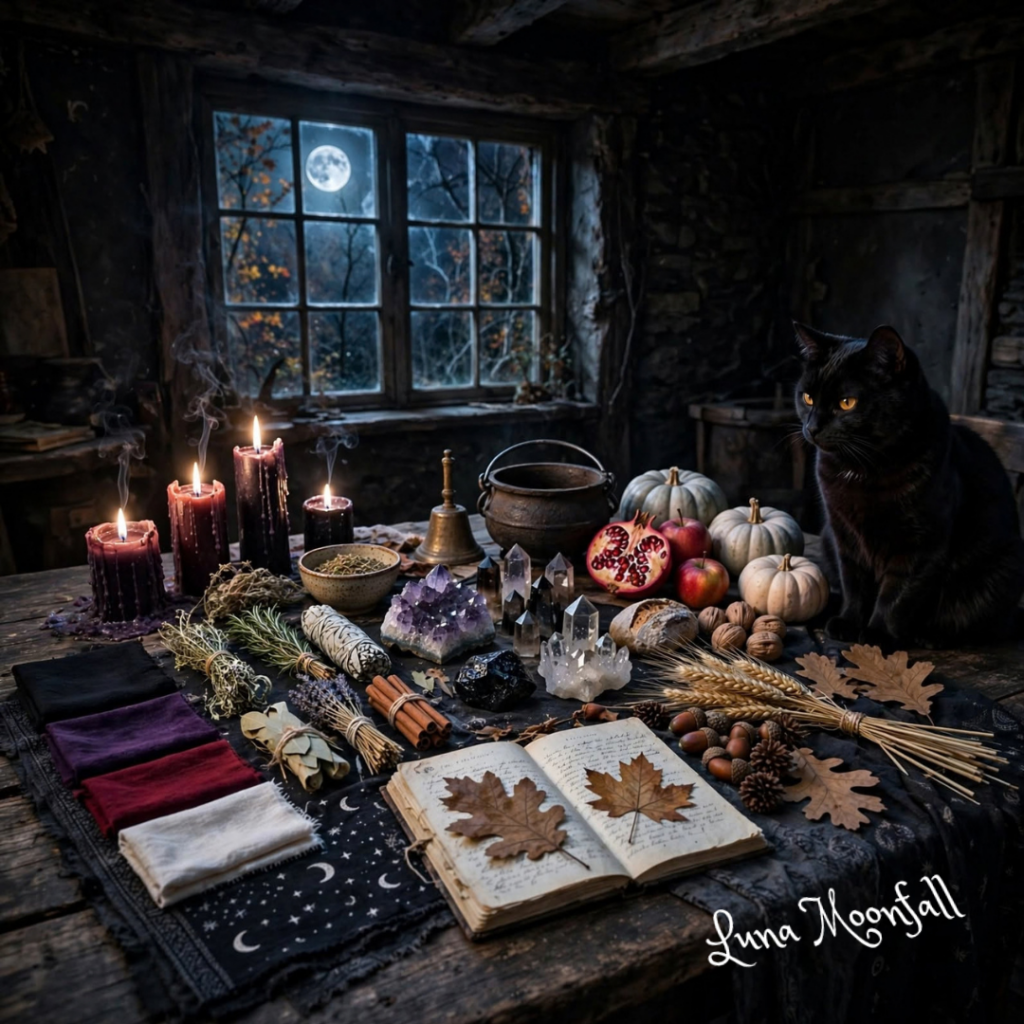
Samhain is a season of endings, remembrance, transformation, and the turning toward winter. For those who observe the Wheel of the Year, it is a powerful time for ancestor work, divination, protection, reflection, and releasing what has reached the end of its cycle.
This collection of Samhain correspondences brings together the colors, herbs, crystals, plants, animals, foods, symbols, tools, and magical themes commonly associated with the season.
Some of these associations come from traditional Irish and Scottish Halloween customs, while others belong to modern witchcraft and Wiccan practice. Correspondences vary between traditions, so use this list as a reference rather than a set of rules.
Samhain at a Glance
| Correspondence | Samhain |
|---|---|
| Season | Late autumn / beginning of winter |
| Traditional date | October 31–November 1 |
| Themes | Death, endings, transformation, remembrance, ancestors, divination |
| Harvest | Final harvest |
| Colors | Black, orange, deep red, brown, purple, silver |
| Plants & herbs | Apple, rosemary, mugwort, sage, hazel, pumpkin, turnip |
| Crystals | Obsidian, smoky quartz, black tourmaline, labradorite, jet, bloodstone |
| Animals | Raven, crow, owl, bat, black cat, stag |
| Foods | Apples, nuts, pumpkins, squash, root vegetables, bread, grains |
| Scents | Smoke, cedar, cinnamon, clove, rosemary, mugwort |
| Tools | Cauldron, besom, candles, divination tools, scrying mirror |
| Magical themes | Ancestor work, divination, protection, releasing, remembrance, transformation |
Samhain traditionally marked the beginning of winter in the Irish calendar, with celebrations taking place primarily on the evening of October 31 and continuing into November 1.
Samhain Colors
Black
Black is one of the strongest modern Samhain colors, reflecting darkness, mystery, death, the unknown, and the quiet season ahead.
Use black candles, altar cloths, ribbons, or other objects symbolically for:
- Protection
- Banishing
- Shadow work
- Ancestor remembrance
- Endings and release
- Divination
Orange
Orange brings the warmth of autumn leaves, harvest, pumpkins, candlelight, and Samhain fire into the darkening season.
Use orange for:
- Harvest magic
- Creativity
- Vitality
- Transformation
- Celebration
- Fire rituals
Deep Red
Deep red represents blood, life, vitality, passion, and the ancestral connection carried through generations.
It can be especially fitting for ancestor altars and rituals focused on family lineage and remembrance.
Brown
Brown connects Samhain to the earth, fallen leaves, forests, roots, and the natural process of decay and renewal.
Purple
Purple is commonly used in modern witchcraft for spiritual work, intuition, mystery, and divination.
Silver
Silver carries lunar and reflective symbolism and works beautifully with Samhain practices involving dreams, intuition, scrying, and the unseen.
Samhain Herbs & Plants
Plants are especially appropriate for Samhain because the season naturally draws our attention toward decay, dormancy, seeds, roots, and the return of life in another cycle.
Apple
Apple is one of the most recognizable fruits associated with Halloween and the Samhain season.
Apples can be used symbolically for:
- Divination
- Offerings
- Love and relationship magic
- Ancestor altars
- Seasonal decoration
Apples and nuts were traditionally gathered as festive foods around Halloween in Ireland, while divination games were also part of seasonal customs.
Rosemary
Rosemary is widely associated with remembrance and makes a natural addition to an ancestor altar.
Use it symbolically for:
- Remembrance
- Protection
- Cleansing
- Honoring the dead
Mugwort
Mugwort is a popular modern witchcraft correspondence for dreams, intuition, divination, and spiritual exploration.
It can be incorporated into:
- Dream sachets
- Divination spaces
- Seasonal incense blends
- Herb bundles
- Altar arrangements
Safety: Mugwort should not be treated as an ordinary culinary herb. Avoid internal use during pregnancy and use appropriate caution with herbal preparations.
Sage
Sage is commonly associated with cleansing, purification, protection, and clearing unwanted energy.
For Samhain, it can be incorporated into seasonal cleansing practices before creating an ancestor altar or beginning divination.
Hazel
Hazel has strong connections with wisdom, knowledge, and divination in Celtic lore and works naturally within a Samhain-inspired altar.
Hazelnuts can be used as seasonal offerings, while hazel branches and leaves can be incorporated into an altar arrangement.
Pumpkin
Pumpkins are strongly associated with modern Halloween and fit naturally into a Samhain altar as an autumn harvest symbol.
For a more historically grounded Irish or Scottish aesthetic, turnips and other root vegetables can also be used. You can read more about why they came to be a custom by reading my post about Stingy Jack.
Samhain Crystals & Stones
Crystal correspondences for Samhain are largely part of modern witchcraft rather than documented ancient Samhain traditions.
Obsidian
Themes: Protection, grounding, shadow work, truth
A fitting stone for deep reflection and looking honestly at what needs to be released.
Smoky Quartz
Themes: Grounding, transition, protection, release
Especially useful as a symbolic stone for reflective practices and seasonal transition.
Black Tourmaline
Themes: Protection, boundaries, grounding
A popular modern choice for protective work and energetic boundaries.
Labradorite
Themes: Transformation, intuition, mystery, liminality
Its shifting colors make it particularly suited to the symbolism of thresholds and changing seasons.
Jet
Themes: Protection, mourning, remembrance
Jet has a long association with mourning jewelry and remembrance, making it particularly evocative for ancestor-focused work.
Bloodstone
Themes: Vitality, courage, grounding
Its deep green and red coloring also makes it visually appropriate for autumn and ancestral altar arrangements.
Garnet
Themes: Vitality, passion, transformation
A rich red stone that works well with the themes of life, death, and renewal.
Samhain Flowers
Samhain is not a season overflowing with flowers, which is part of what makes the remaining blooms meaningful.
Consider:
- Chrysanthemums
- Marigolds
- Dried roses
- Late-season wildflowers
- Dried herbs
- Autumn leaves
- Seed heads
- Dried grasses
If incorporating flowers from another cultural tradition, such as marigolds associated with Día de los Muertos, it is worth learning about that tradition separately instead of treating every autumn death-related practice as interchangeable.
Samhain Animals
Animals frequently appear in modern Samhain symbolism because the season is associated with darkness, forests, night, mystery, and the unseen.
Raven & Crow
In modern witchcraft, ravens and crows are often associated with:
- Mystery
- Intelligence
- Prophecy
- Transformation
- Death and rebirth
Owl
Owls are commonly associated with:
- Night vision
- Wisdom
- Intuition
- Seeing what is hidden
Stag
The stag can represent the wild forest, strength, masculine energy, and the turning seasonal cycle in modern pagan symbolism.
Bat
Bats naturally fit Samhain’s nocturnal symbolism and can represent:
- Transformation
- Rebirth
- Night
- Moving through darkness
Black Cat
Black cats have become strongly associated with Halloween and modern witchcraft.
For a Samhain altar, a black cat can symbolize mystery, independence, intuition, and the familiar spirit.
Samhain Foods
Food is one of the easiest ways to bring Samhain into your home.
Traditional Halloween customs in Ireland included seasonal foods such as fruit and nuts, along with games and divination.
Seasonal Samhain Foods
- Apples
- Hazelnuts
- Walnuts
- Pumpkin
- Squash
- Turnips
- Potatoes
- Root vegetables
- Corn
- Grains
- Breads
- Cider
- Seasonal soups and stews
A simple Samhain meal can become an act of remembrance by preparing foods connected to your own family history.
Samhain Symbols
Common modern Samhain symbols include:
- Fallen leaves
- Apples
- Nuts
- Pumpkins
- Turnips
- Candles
- Bonfires
- Cauldrons
- Skulls
- Bones
- Ravens and crows
- Owls
- Bats
- Black cats
- Bare branches
- Seeds
- Doorways
- Keys
- Mirrors
- Tarot cards
- The moon
Some of these are modern witchcraft symbols, while others have connections to traditional Halloween customs.
Fire is particularly important to the history of Samhain. Historical accounts describe communal fires associated with the festival, while modern practitioners often incorporate candlelight or fire symbolism into seasonal practice.
Samhain Magical Themes
Ancestor Work
Samhain is perhaps most strongly associated in contemporary witchcraft with remembering the dead.
Ancestor work might include:
- Creating an ancestor altar
- Lighting candles in remembrance
- Displaying photographs
- Preparing a favorite family recipe
- Speaking the names of loved ones who have passed
- Writing memories in a journal
- Leaving a symbolic offering
Read more in our guide to Samhain Ancestor Work.
Divination
Samhain is traditionally connected with divination and fortune-telling customs.
Modern practitioners may work with:
- Tarot
- Oracle cards
- Runes
- Pendulums
- Scrying
- Bibliomancy
- Dream work
- Apple divination
Historical Irish Halloween traditions included marriage divination games and other forms of fortune-telling.
Protection
Protection is another important Samhain theme.
Consider:
- Protective herbs
- Black candles
- Salt
- Protective stones
- Doorway charms
- Cleansing rituals
- Protective sigils
Historical Irish Halloween customs also included protective symbols placed above doors to guard the home from misfortune.
Releasing & Letting Go
Samhain’s position at the end of the harvest season makes it a natural time for reflection.
Modern witches often use this season to consider:
- What has ended
- What needs to be released
- Habits that no longer serve them
- Relationships or situations that have changed
- Lessons from the past year
- What they want to carry forward
Shadow Work
The darkness of Samhain makes it a natural symbolic setting for exploring the parts of ourselves that are usually easier to avoid.
Shadow work might involve journaling about fears, patterns, grief, boundaries, or personal growth.
Samhain Magical Tools
You don’t need a large collection of ritual tools to observe Samhain.
Cauldron
A cauldron can represent transformation, cooking, creation, and the changing of one thing into another.
Besom
A besom, or ritual broom, can be used symbolically for cleansing and clearing.
Candles
Use black, orange, red, purple, white, or silver candles according to your intention.
Scrying Mirror
A dark reflective surface can be incorporated into divination practices.
Tarot or Oracle Cards
Tarot and oracle cards can be used for seasonal reflection, divination, and year-ahead readings.
Pendulum
A pendulum provides another option for personal divination and intuitive reflection.
Ancestor Altar
A simple table or shelf with photographs, candles, meaningful objects, and seasonal offerings can become the center of your Samhain practice.
Samhain Deities
Deity associations vary significantly between traditions.
There is no single universal list of Samhain deities, and not every deity commonly found on modern Samhain correspondence lists has a historical connection to the festival.
Modern practitioners may work with deities whose mythology relates to:
- Death
- The underworld
- Crossroads
- Fate
- Sovereignty
- Winter
- Transformation
- The wild
- Ancestors
Names commonly encountered in modern Samhain practice include:
- The Morrígan
- Cernunnos
- The Cailleach
- Cerridwen
- Hecate
- Anubis
- Osiris
- Persephone
- Hades
These belong to different mythological traditions, so they should not be presented as though they all form part of one historical Celtic Samhain tradition.
For example, Hecate is Greek, not Celtic. Her inclusion in contemporary Samhain practice comes from modern devotional and witchcraft traditions connecting her with crossroads, night, spirits, and liminal spaces.
Samhain Intentions
If you’re using Samhain as a time for reflection, these intentions fit naturally with the season:
Release — What am I ready to leave behind?
Remember — Who and what deserves to be honored?
Reflect — What did this past cycle teach me?
Protect — What boundaries need strengthening?
Transform — What is changing in my life?
Rest — Where can I stop forcing growth?
Prepare — What do I want to carry with me into the next cycle?
Samhain Altar Correspondences
A simple Samhain altar could include:
For remembrance:
Photographs, heirlooms, a candle, favorite foods
For protection:
Black candle, salt, protective herbs, black tourmaline
For divination:
Tarot cards, oracle cards, pendulum, scrying mirror
For the harvest:
Apples, nuts, pumpkin, squash, grains, autumn leaves
For transformation:
A cauldron, candle flame, dried leaves, seeds
For the season:
Black, orange, deep red, brown, purple, and silver accents
Even a single candle and a seasonal offering can be enough to create a meaningful focal point.
A Note About Samhain Correspondences
Correspondence lists can make witchcraft feel like there is a single correct answer for every herb, crystal, color, or deity. In practice, correspondences vary between traditions and individual practitioners.
Some Samhain associations have roots in documented Irish and Scottish folk customs. Others developed through modern Wicca, contemporary Paganism, folk magic, or individual practice.
That distinction is worth keeping in mind.
The most useful correspondence is often the one that has meaning within your own practice.
Quick Samhain Correspondence Chart
| Category | Correspondences |
|---|---|
| Colors | Black, orange, deep red, brown, purple, silver |
| Herbs | Rosemary, mugwort, sage, wormwood, hazel |
| Plants | Apple, pumpkin, turnip, oak, ivy, autumn leaves |
| Crystals | Obsidian, smoky quartz, black tourmaline, labradorite, jet, bloodstone, garnet |
| Flowers | Chrysanthemum, marigold, dried roses |
| Animals | Raven, crow, owl, bat, stag, black cat |
| Foods | Apples, nuts, pumpkin, squash, turnips, potatoes, grains, bread |
| Scents | Smoke, cinnamon, clove, rosemary, cedar |
| Symbols | Skulls, bones, leaves, apples, pumpkins, candles, cauldrons, ravens |
| Tools | Cauldron, besom, candles, tarot, oracle cards, pendulum, scrying mirror |
| Themes | Ancestors, remembrance, death, transformation, divination, protection, release |
| Magical work | Ancestor work, divination, protection, cleansing, banishing, shadow work, reflection |
More Samhain Resources
If you’re building your Samhain practice, explore these related Moonfall Metaphysical guides:
- Samhain: Meaning, Traditions & Ways to Celebrate
- Samhain Altar Ideas: 15 Witchy Ways to Create a Meaningful Altar
- Samhain Rituals for the Witch’s New Year
- Samhain Divination & Tarot
- Samhain Ancestor Work
- Samhain Herbs & Their Magical Uses