
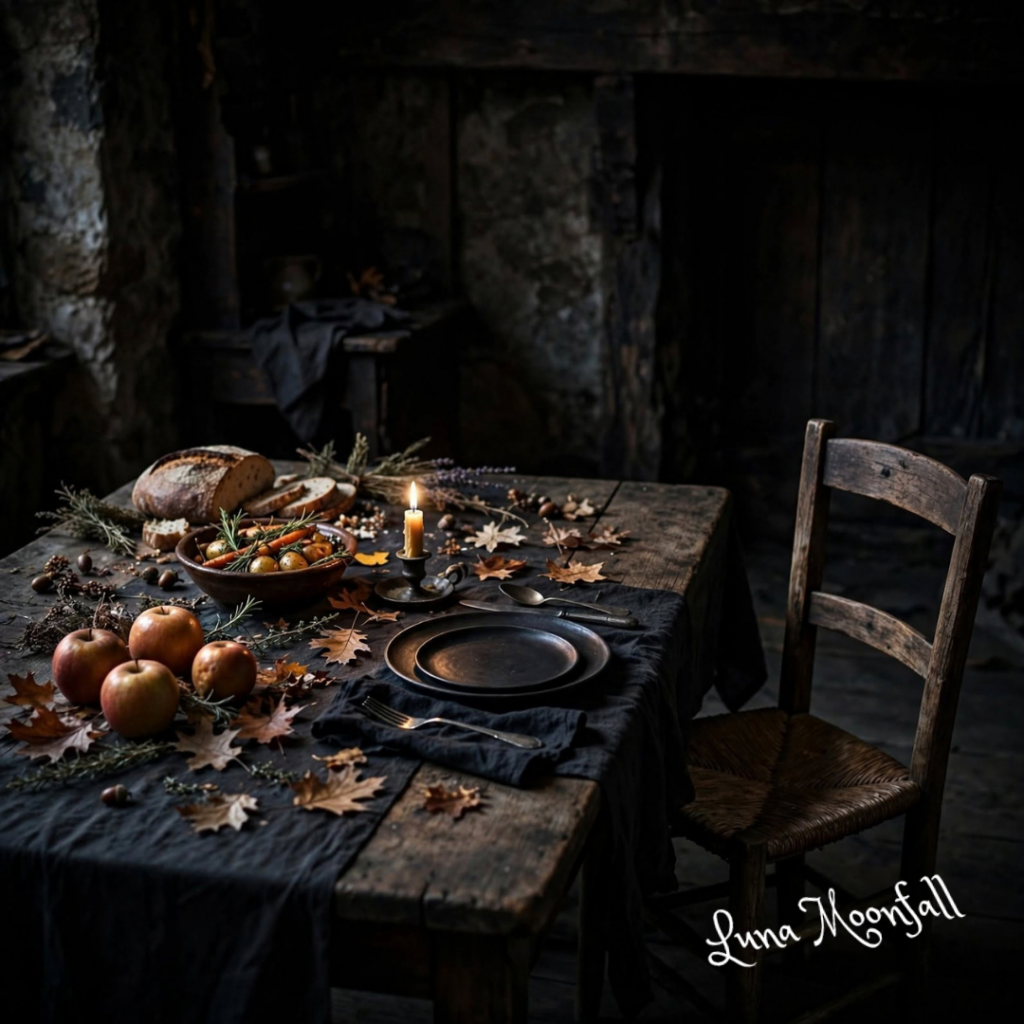
There are plenty of ways to celebrate Samhain.
You can light a bonfire, pull tarot cards, carve a turnip, make offerings, decorate an altar, or spend the evening watching something suitably creepy with a bowl of Halloween candy.
Or you can set the table.
Put an extra plate at one end. Light a candle. Prepare a meal. Then sit down and eat it in silence.
This is the heart of a dumb supper, sometimes called a silent supper or feast for the dead.
For many, a dumb supper is a way to honor deceased loved ones and ancestors during Samhain. The meal becomes an act of remembrance rather than an ordinary dinner. The empty place at the table represents someone who is no longer physically there, while the silence gives you space to remember them without the usual noise and distractions of everyday life.
And despite how elaborate some versions can become, you don’t need an enormous feast, a perfectly decorated altar, or a house full of candles.
You need a table, something to eat, someone to remember, and a little quiet.
What Is a Dumb Supper?
A dumb supper is a meal eaten in silence, traditionally with one or more places set for the dead.
The word dumb is being used in its older sense of unable or unwilling to speak. It has nothing to do with intelligence.
The meal is usually held around Samhain and focuses on remembrance, ancestor honoring, and reflection.
An extra place is set at the table for a deceased loved one or ancestor. Their photograph, a personal object, or a favourite food may be placed nearby. The living participants then share the meal in silence.
Some practitioners treat the empty place as an invitation to the spirit of a specific person. Others see it symbolically: a physical reminder that someone who was once part of their lives is still remembered.
Both approaches can have a place in modern witchcraft.
Is a Dumb Supper an Ancient Samhain Tradition?
This is where the history gets interesting.
You’ll often see dumb suppers described online as an ancient Celtic or traditional Samhain ritual. The reality is more complicated.
The modern ancestor-focused dumb supper appears to draw from several different strands of folk and Pagan practice. Historical accounts of dumb suppers in Britain and parts of rural America describe silent meals connected with divination, particularly love divination. In some traditions, young women prepared a meal in silence and left an empty place for a future husband, hoping for a supernatural appearance or other sign.
Appalachian and Ozark folklore preserves versions of these Halloween customs, including meals prepared and eaten in silence and tables arranged in unusual or reversed ways.
The ancestor-focused version familiar to modern witches developed later within contemporary Pagan practice. The silence, the empty place, the meal, and the liminal atmosphere fit naturally with modern Samhain observances centered on ancestors and the dead.
So while there is genuine folk history behind the dumb supper, it is more accurate to think of the modern Samhain version as a living tradition that has evolved over time, rather than an unchanged ritual handed down from ancient Celtic Ireland.
And honestly, that makes it no less meaningful.
Witchcraft is full of practices that have been adapted, reinterpreted, and carried forward by different generations. Knowing where a custom comes from allows us to participate in it with a little more awareness.
Why Hold a Dumb Supper at Samhain?
Samhain is strongly associated with endings, remembrance, ancestors, and the transition from autumn into winter.
Within contemporary Pagan practice, it is often treated as a time to remember people who have died and reflect on the cycle of life, death, and renewal.
A silent meal fits into those themes.
There is something very different about eating dinner when nobody is talking.
You notice the scrape of a fork against a plate. The sound of the kettle in the kitchen. The flicker of a candle. The chair across from you that would normally be occupied.
Silence makes the absence noticeable.
It also creates room for memory.
You might find yourself remembering someone’s laugh, the way they made coffee, a family story you’ve heard a hundred times, or something completely ordinary that you hadn’t thought about in years.
Those ordinary memories are often the most precious ones.
Who Should You Invite to a Dumb Supper?
You can make your dumb supper as personal as you like.
You might dedicate the meal to:
- A parent or grandparent
- A partner or spouse
- A sibling
- A friend
- A beloved pet
- An ancestor you knew personally
- Ancestors whose names you don’t know
- Several deceased loved ones
- Your wider ancestral line
You can also choose not to name anyone specifically.
A place can simply be set for the beloved dead or those who came before.
If the idea of inviting spirits into your home makes you uncomfortable, you don’t need to do that.
Your dumb supper can be entirely about remembrance.
Think of it as setting a place for someone you miss.
What You Need for a Dumb Supper
You don’t need special witchcraft supplies.
For a simple dumb supper, gather:
- A table or dining space
- A plate and place setting for each living participant
- One additional place setting
- A candle or LED candle for the empty place
- Food for the meal
- A drink
- A photograph or meaningful object, if desired
You can add flowers, autumn leaves, apples, candles, seasonal decorations, or items belonging to the person you’re remembering.
Black and autumn colours are popular choices for Samhain, but you don’t need to create a gothic banquet hall unless that happens to be your thing.
Your everyday dishes are perfectly acceptable.
Choosing the Date
A dumb supper is commonly associated with Samhain and Halloween, making the evening of October 31 a natural choice.
You can also hold one at another point during the Samhain season.
If October 31 is already filled with trick-or-treaters, parties, work, family commitments, or general Halloween chaos, choose another evening.
The meaning of the ritual isn’t going to disappear because you celebrated on October 29 instead of October 31.
Choose a time when you can actually be present.
How to Prepare for Your Dumb Supper
The preparation is part of the ritual.
Clean the table. Tidy the room. Choose your food. Put away anything that will interrupt the evening.
Turn off the television. Silence your phone. Decide whether you want music playing before the meal and when it will stop.
If you’re hosting other people, explain the ritual beforehand.
Once the supper begins, there should be no confusion about whether someone is allowed to whisper a question about the potatoes.
Save the potato questions for later.
Choose the Meal
There is no required dumb supper menu.
A simple seasonal meal might include:
- Fresh bread
- Roasted potatoes
- Root vegetables
- Squash or pumpkin
- Soup or stew
- Apples or pears
- Nuts
- Seasonal vegetables
- Apple bread or another autumn dessert
- Tea, cider, or another favourite drink
But the most meaningful food may have nothing to do with a Samhain correspondence list.
If your grandmother was famous for her apple pie, make apple pie.
If your father loved pancakes, make pancakes.
If the person you’re remembering would have ordered pizza without hesitation, order pizza.
A favourite food can carry more meaning than a perfectly researched seasonal recipe.
Set the Table
Set the table as you normally would, then add one extra place.
The additional setting can be at the head of the table, at the end, or wherever feels natural.
Place a plate, cutlery, glass, and napkin at the empty setting.
You can also add:
- A photograph
- A favourite object
- A flower
- A small candle
- A favourite drink
- A serving of their favourite food
Some people place a candle at the empty setting as a symbolic light for the person being remembered.
If you are using real candles, keep them well away from photographs, dried leaves, flowers, fabric, and other flammable decorations.
Battery-operated candles work beautifully too.
Create an Ancestor Space
If you already have an ancestor altar, you can incorporate it into your dumb supper.
Place photographs or meaningful objects nearby, or move a small selection of them to the dining table for the evening.
You don’t need photographs if you don’t have them.
Perhaps you have an old recipe card, a piece of jewellery, a handwritten note, a book, or an object that reminds you of someone.
And if you know very little about your ancestors, that’s okay too.
You can dedicate the meal to those whose names have been forgotten.
Hosting a Dumb Supper: Step by Step
1. Prepare the Meal
Cook your meal and prepare the table before beginning the formal part of the ritual.
If you want to incorporate the silence into the preparation, begin observing it once the ritual starts. Otherwise, prepare everything normally and enter the silent portion once the table is ready.
2. Light the Candle
Light the candle at the empty place.
Take a moment to look at the setting.
Think about who you are remembering and why you chose to include them in this evening.
3. Open the Supper
You can speak a few words before the silence begins.
There is no required invocation.
Speak naturally and keep it simple.
You might say:
Tonight, I set this place in remembrance of those who have gone before me and those I carry in my heart.
You are remembered. You are honoured. You are welcome at this table.
May this meal be shared in love and gratitude.
Use your own words if you’d rather.
4. Begin the Silence
Once the meal begins, no one speaks.
Put away the phones.
Turn off the television.
Let the room become quiet.
You don’t need to force yourself to think about anything in particular.
Eat slowly. Notice the food. Notice the people around you. Let memories come and go.
If you’re alone, simply sit with the empty place.
5. Serve the Empty Place
Some traditions serve the spirit’s place first.
If that feels meaningful to you, place a small serving of food and drink at the empty setting before serving everyone else.
There is no need to pile an entire dinner onto the plate. A small portion is enough.
If you’re uncomfortable leaving food sitting out for hours, serve a symbolic portion and dispose of it respectfully afterward.
6. Eat in Silence
This is the central part of the dumb supper.
There is no conversation.
No stories.
No phones.
No explaining what you’re thinking.
Just the meal and the people gathered around the table.
If a memory surfaces, let yourself experience it.
You might smile.
You might cry.
You might remember something completely ridiculous.
That’s all part of remembering a person as a whole human being.
7. Remember
If you’re sharing the supper with other people, everyone can privately reflect on the person or people they are remembering.
You don’t need to speak their names during the meal.
Think about their life.
Think about what they taught you.
Think about the things you wish you could tell them.
Think about the ordinary moments you wish you could experience one more time.
And if you believe the dead can hear you, you can hold those thoughts as a silent conversation.
8. Finish the Meal
When everyone has finished eating, remain quiet for another few moments.
There is no need to rush out of the silence.
Let the evening settle.
9. Say Goodbye
When you’re ready, speak again.
Thank the people you remembered for the lives they lived and the parts of themselves they left with you.
You might say:
Thank you for sharing this meal with me.
You are remembered, and you are loved.
May you go in peace, and may I carry your memory with me.
Again, use whatever words feel right.
10. Close the Ritual
Extinguish the candle safely.
Clear the table when you’re ready.
If you left food or drink at the empty setting as an offering, decide ahead of time what you will do with it.
You can dispose of it respectfully, compost suitable food, or consume it yourself if that fits your practice.
There is no need to leave food outdoors overnight, especially if it could attract wildlife.
What If You Want to Invite Spirits?
Some approach a dumb supper as an opportunity to invite deceased loved ones or ancestors to join them.
If that is part of your practice, you can make the invitation explicit.
Before the silence begins, name the person or people you wish to honour.
You might say:
If you are able and willing to join me, this place is set for you.
Come in peace, sit in peace, and share this meal in love.
Then begin the silence.
You don’t need to attempt communication, ask for signs, use a spirit board, or perform a séance.
A dumb supper can simply be an invitation and a meal.
If nothing unusual happens, that doesn’t mean the ritual failed.
The purpose is remembrance, not paranormal proof.
What If You Don’t Want to Invite Spirits?
You can still hold a dumb supper.
This is particularly important for anyone who enjoys Samhain but doesn’t feel comfortable with spirit work.
Instead of inviting anyone to physically or spiritually join you, frame the meal as an act of remembrance.
The empty chair represents someone who is absent.
The photograph represents memory.
The candle represents the light their life brought into yours.
The silence gives you space to remember.
Nothing supernatural needs to happen for the evening to be meaningful.
A Dumb Supper for One
You don’t need a group to host a dumb supper.
In fact, a solitary supper can be incredibly intimate.
Prepare a meal you associate with someone you’ve lost.
Set one place for yourself and another for the person you’re remembering.
Put a photograph or meaningful object at their place.
Light a candle.
Speak your opening words.
Then eat in silence.
Afterward, sit for a few minutes before saying goodbye and closing the ritual.
For someone who is grieving, this can be a particularly gentle way to acknowledge that a person is missing while still celebrating the life they lived.
Hosting a Dumb Supper With Friends or Family
A group dumb supper requires a little more preparation.
Explain the rules before everyone sits down. Make sure everyone understands that the meal itself will be silent.
Each participant can choose someone they wish to remember.
You can have one shared empty setting or allow each participant to set a place for their own loved one.
One person can give the opening and closing words, after which everyone observes silence.
If you’re hosting children, keep the ritual age-appropriate. A child can participate by placing a flower, drawing a picture, or remembering someone without being expected to understand every spiritual aspect of the practice.
Can You Talk During a Dumb Supper?
The traditional feature of the practice is silence, so talking is generally avoided once the supper begins.
But there is no universal rulebook for modern dumb suppers.
If someone accidentally speaks, the universe isn’t going to issue you a citation.
Simply return to the silence.
If you are hosting someone who cannot comfortably remain silent for an extended period, adapt the practice. The point is to create a meaningful period of quiet, not to make someone anxious about breaking a magical rule.
How Long Should a Dumb Supper Last?
There is no required length.
A simple supper might last thirty minutes.
A larger meal might last an hour or more.
You can also remain at the table for several minutes after eating, allowing the silence to continue.
Choose a length that feels natural.
There is no prize for sitting silently beside a cold plate of potatoes for four hours.
Should You Eat the Food at the Empty Place?
This depends on your beliefs and the way you approach offerings.
Some practitioners leave the food untouched as an offering.
Others place a symbolic portion at the empty setting and later dispose of it.
Others incorporate the food into the meal afterward.
If you are leaving food outdoors, be mindful of local wildlife and avoid creating problems for animals or neighbours.
You can also use a small symbolic offering rather than an entire plate of food.
Dumb Supper Ideas for Your Samhain Table
If you’d like to make the evening feel a little more special, consider adding a few seasonal touches.
- Autumn leaves
- Apples
- Dried flowers
- Acorns or pinecones
- Seasonal vegetables
- Black, white, deep red, or purple candles
- A favourite family recipe
- Photographs
- Handwritten recipes or letters
- Family heirlooms
- Fresh bread
- Tea, cider, or another meaningful drink
Keep the decorations secondary to the purpose of the evening.
This isn’t a tablescape competition.
If the most meaningful thing you own is an old photograph and your favourite mug, use those.
Questions to Reflect on During a Dumb Supper
You don’t need to actively journal during the meal. Save these questions for quiet reflection or write about them afterward.
- What do I remember most clearly about this person?
- What did they teach me?
- What part of them lives on in me?
- What story about them do I never want to forget?
- What am I grateful they brought into my life?
- What would I tell them if they were sitting here?
- What family story deserves to be remembered?
- What have I inherited from those who came before me?
Sometimes the answer isn’t profound.
Maybe you inherited your mother’s stubbornness.
Your grandfather’s terrible jokes.
Your aunt’s recipe for cinnamon buns.
Your father’s habit of checking the weather three times before leaving the house.
Those little things are part of a person’s legacy too.
A Simple Dumb Supper Ritual
If you want the entire practice condensed into something you can follow without scrolling through an enormous ritual guide while your dinner gets cold, use this version.
- Choose someone or a group of ancestors to remember.
- Prepare a simple meal.
- Set the table and add one extra place.
- Place a photograph, object, candle, or favourite food at the empty setting.
- Light the candle.
- Speak a short invitation or remembrance.
- Begin the meal.
- Remain silent while you eat.
- Spend the meal remembering the people you’re honouring.
- When finished, sit quietly for a few moments.
- Speak your thanks and say goodbye.
- Extinguish the candle safely and close the ritual.
That’s it.
You don’t need a complicated invocation.
You don’t need expensive ritual tools.
You don’t need a house covered in black candles.
You don’t need to communicate with the dead.
You simply need to make room at the table for remembrance.
Making the Dumb Supper Your Own
One of the things I love about the dumb supper is how easily it can become personal.
Maybe you prepare your grandmother’s favourite meal every Samhain.
Maybe you set a place for everyone in your family who has passed away.
Maybe you honour a beloved pet.
Maybe you use the evening to remember ancestors whose names were lost generations ago.
Maybe you don’t believe in spirits at all and simply appreciate the opportunity to slow down and remember the people whose lives helped shape your own.
All of those approaches can coexist.
There is no single correct table.
There is no required menu.
There is no special candle colour that makes the ritual work.
What matters is the attention you bring to it.
When the Dinner Is Over
Eventually, the candles go out and the dishes need washing.
The ordinary world returns.
That’s okay.
A dumb supper doesn’t need to end with a supernatural experience. It doesn’t need a mysterious sign, a flickering candle, or a ghostly figure appearing at the empty place.
Sometimes the most powerful thing that happens is much quieter.
You remember.
You tell a story later.
You make the recipe again next year.
You realize you still remember exactly how someone laughed.
You carry a little piece of them back into your everyday life.
That is a pretty good reason to set the table.
Frequently Asked Questions About Dumb Suppers
What does “dumb supper” mean?
In this context, dumb is an older word meaning silent or unable to speak. A dumb supper is a meal eaten in silence, often with an empty place set for the dead.
Is a dumb supper a Samhain tradition?
Dumb suppers are strongly associated with modern Samhain practice, particularly as an ancestor-honoring ritual. However, the historical roots of the named practice are more complicated than the phrase “ancient Celtic ritual” suggests. Historical dumb suppers were also associated with British and Appalachian folk divination, especially love divination.
Do I have to invite spirits to a dumb supper?
No. You can treat the meal as an act of remembrance without inviting spirits or attempting communication with the dead.
Can I hold a dumb supper by myself?
Absolutely. A solitary dumb supper can be a quiet and meaningful way to remember someone you’ve lost.
What food should I serve at a dumb supper?
There is no required menu. Seasonal foods such as bread, apples, root vegetables, squash, potatoes, soup, and cider work well, but a deceased loved one’s favourite food can be even more meaningful.
Does the entire meal have to be silent?
Silence is the defining feature of the practice, but modern dumb suppers can be adapted. If you accidentally speak, simply return to the silence. The ritual is meant to create space for remembrance, not anxiety.
Can I include pets in a dumb supper?
Yes. If you’ve lost a beloved animal, you can include their photograph, favourite treat, toy, or another meaningful object at the table.
What should I do with the food afterward?
That depends on your practice. You can dispose of a symbolic offering respectfully, compost suitable food, or consume it yourself. Avoid leaving food outdoors if it could attract wildlife or create a nuisance.
A Seat at the Table
Samhain is often described as a time when the veil grows thin.
Whether you understand that literally, symbolically, spiritually, or simply as a beautiful seasonal metaphor, there is something powerful about making room for the people who are no longer physically here.
Set the table.
Light the candle.
Put away the phone.
Eat slowly.
Remember someone.
For one meal, let the world be quiet.
And when the supper is over, carry the memories with you.
The dead may no longer sit at our tables in the way they once did.
But the places they held in our lives don’t disappear simply because the chair is empty.
Sometimes remembrance is its own kind of magic.