
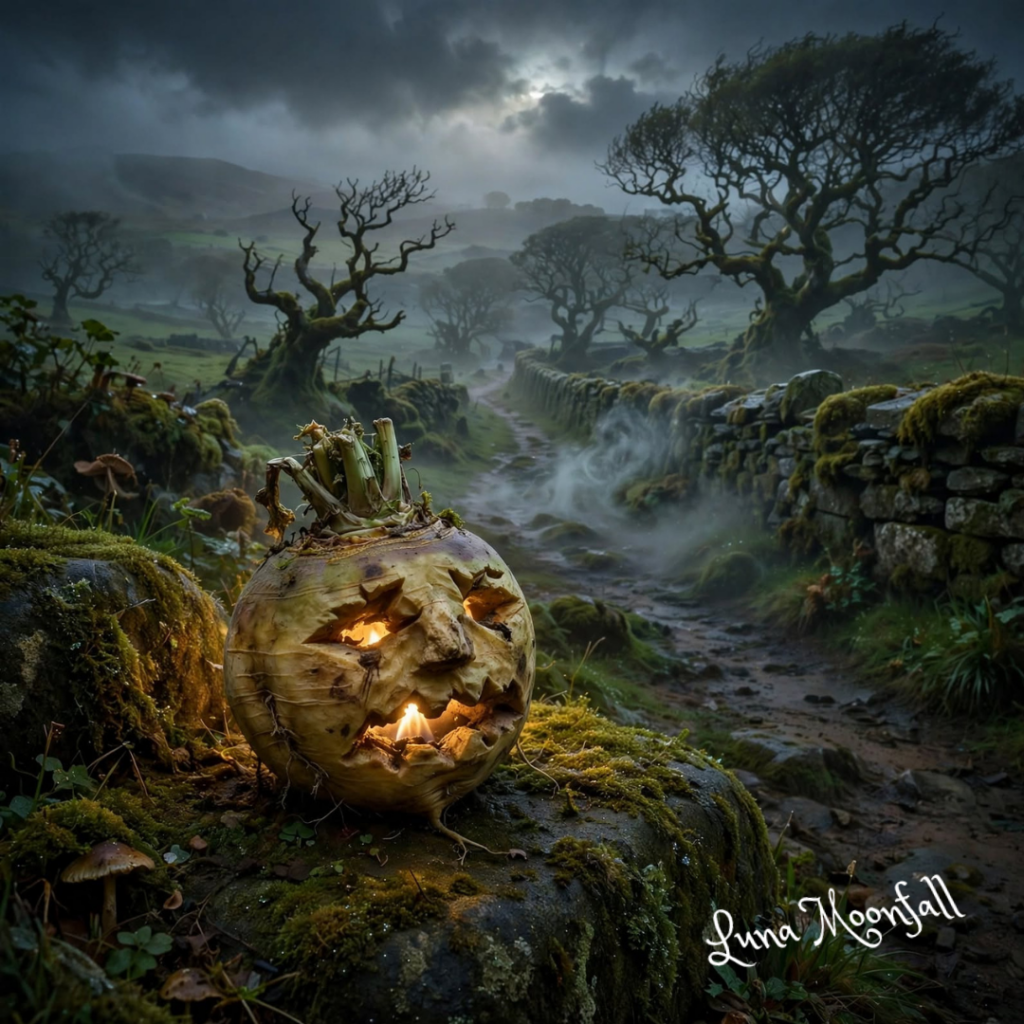
Every autumn, carved pumpkins begin appearing on porches, windowsills, and doorsteps. Their glowing faces have become one of the most recognizable symbols of Halloween. But before pumpkins became the traditional canvas for those crooked smiles, people in Ireland and other parts of the British Isles carved faces into turnips and other root vegetables.
Behind the name jack-o’-lantern is an old Irish folktale about a troublesome man called Stingy Jack. According to the story, Jack was clever enough to trick the Devil more than once. His bargains protected him from Hell, but they did not earn him a place in Heaven. When Jack finally died, he was left wandering in darkness with nothing but a burning coal to light his way.
That eerie tale became intertwined with an older tradition of carrying and displaying carved vegetable lanterns. Over time, the story of Stingy Jack and the tradition of the jack-o’-lantern became inseparable.
So who was Stingy Jack, and how did his strange fate become part of Halloween folklore?
Who Was Stingy Jack?
Stingy Jack is a character from Irish folklore, although the story exists in several versions. He is sometimes described as a blacksmith, a drunkard, a miser, or simply a clever and unpleasant man who enjoyed getting the better of other people.
The details change from one telling to another, but the heart of the story remains remarkably consistent: Jack repeatedly outwits the Devil, only to discover that his clever bargains have left him with nowhere to go after death.
His nickname, “Stingy Jack,” reflects his reputation for selfishness and dishonesty. He is not presented as a heroic figure. His cleverness may save him from immediate consequences, but each trick creates another problem down the road.
That makes Jack an interesting figure in folklore. He is neither a traditional villain nor a noble trickster. He survives through cunning, but his cunning ultimately becomes his punishment.
The Legend of Stingy Jack
There are several versions of the tale, so the story below follows the best-known form while allowing for some of the differences found in traditional retellings.
Jack Meets the Devil
One evening, Stingy Jack encounters the Devil and realizes that his time may be running out.
Jack is not ready to give up his life—or his freedom. Using his usual cleverness, he convinces the Devil to transform himself into a coin so Jack can use it to pay for a drink.
Instead of spending the coin, Jack places it beside a silver cross, preventing the Devil from changing back.
Jack then makes a bargain.
He will release the Devil if the Devil promises not to claim Jack’s soul for a certain period of time.
The Devil agrees, and Jack gets his way.
Jack Tricks the Devil Again
Years later, Jack encounters the Devil once more.
Once again, Jack manages to turn the situation to his advantage.
In one popular version of the story, Jack asks the Devil to climb a tree and retrieve some fruit. While the Devil is in the branches, Jack places a cross beneath the tree, trapping him there.
Jack refuses to remove the cross until the Devil agrees that he will never claim Jack’s soul.
The Devil accepts.
Jack has managed to escape Hell twice.
For a while, it seems as though his cleverness has worked.
Jack Dies
Eventually, Jack dies.
But death does not bring him the freedom he expected.
When Jack arrives at Heaven’s gates, he is refused entry because of the way he lived his life. He turns toward Hell instead, believing there must at least be a place for him there.
But the Devil remembers Jack.
Because of their earlier bargains, the Devil cannot claim Jack’s soul. He refuses to allow Jack into Hell.
Jack is caught between the two realms.
The Lantern in the Darkness
According to the familiar version of the legend, Jack is left to wander in darkness.
The Devil gives him a burning coal from the fires of Hell to light his way.
Jack places the coal inside a hollowed-out turnip and begins his endless journey through the darkness.
He becomes known as Jack of the Lantern, eventually shortened to jack-o’-lantern.
His glowing lantern becomes a symbol of a wandering soul with no place to rest.
Why Is He Called Stingy Jack?
The word “stingy” is important to the character.
Jack’s problem is not that he lacks intelligence. Quite the opposite. He is extremely resourceful. His downfall comes from the way he uses that cleverness.
He bargains, deceives, manipulates, and looks for ways to escape the consequences of his choices.
Folklore often uses characters like Jack to explore the limits of cleverness. A trick may solve one problem while creating another, and getting out of every immediate consequence does not necessarily lead to a happy ending.
Jack’s story works as a cautionary tale as much as a ghost story.
What Is a Jack-o’-Lantern?
The term jack-o’-lantern did not originate solely with the Stingy Jack story.
The name was also associated with mysterious lights seen at night, particularly the flickering lights sometimes reported around marshes and bogs. These natural phenomena became known by names such as will-o’-the-wisp, ignis fatuus, and Jack-o’-Lantern.
To people traveling through dark countryside, a strange light appearing in the distance could easily become the subject of supernatural stories.
The idea of a wandering spirit carrying a light fit naturally with the folklore surrounding Stingy Jack.
Eventually, the name became associated with the carved lantern itself.
Before the Pumpkin: The Turnip Lantern
The modern Halloween pumpkin can make it easy to forget that pumpkins were not the original material used for jack-o’-lanterns in Ireland.
Turnips were much more common.
People in Ireland and parts of Britain carved faces into turnips, potatoes, beets, and other vegetables. The hollowed-out vegetables could hold a candle or ember, creating a small lantern that glowed through the carved openings.
Some of these carvings were deliberately frightening.
They could have grotesque faces, exaggerated teeth, hollow eyes, and other features designed to look unsettling in the darkness.
The practical side of the tradition is worth remembering, too. Before today’s electric lighting, a hollowed root vegetable provided a cheap way to carry or display a small light. Metal lanterns were more expensive, so vegetables offered an accessible alternative.
The result was both practical and eerie: a candle glowing from inside a strange face in the darkness.
Stingy Jack and Samhain
Stingy Jack is frequently described online as an ancient Samhain figure. The history is more nuanced.
Samhain is an important Gaelic seasonal festival traditionally associated with the transition from the harvest season into winter. Over time, Halloween developed through a mixture of older seasonal customs, Christian observances, local folklore, and later traditions.
Stories about spirits, supernatural beings, divination, disguises, fires, and carved lanterns became connected with this autumn threshold.
The Stingy Jack story belongs to the folklore surrounding this broader Halloween tradition. It should not be treated as an ancient Celtic myth that was necessarily told at Samhain in exactly the form we know today.
That distinction does not make the story any less fascinating. Folklore changes as it is passed from one generation to another, and the way stories become attached to seasonal customs is part of what makes them so interesting.
Historical sources also document the use of carved turnip lanterns in Ireland and other parts of the British Isles. The Library of Congress notes that the familiar Stingy Jack explanation for the jack-o’-lantern was already appearing in American newspaper accounts by the early twentieth century.
From Irish Turnips to American Pumpkins
When Irish immigrants came to North America, they brought their Halloween customs and folklore with them.
They also encountered a vegetable that was much easier to carve than a turnip: the pumpkin.
Pumpkins are native to the Americas, and their large size, hollow interior, and softer flesh made them ideal for creating lanterns.
Over time, the pumpkin became the familiar jack-o’-lantern of modern Halloween.
The transformation was practical as much as symbolic. A pumpkin could produce a much larger and more dramatic lantern than a turnip, while its thick orange skin created a striking contrast against candlelight.
By the nineteenth century, carved pumpkin lanterns were becoming part of American Halloween celebrations. Irish and Scottish immigrant traditions helped shape the customs that eventually became associated with the pumpkin jack-o’-lantern we recognize today.
Why Did People Carve Faces Into Lanterns?
Some folklore connects frightening faces with the idea of frightening away unwanted spirits. Other traditions treated the lantern as a representation of a supernatural being or wandering soul.
There was also a playful side to the custom.
Halloween has long been associated with mischief, disguises, pranks, and supernatural storytelling. A grotesque face glowing from a dark doorway fits perfectly into that atmosphere.
The carved face may have represented something frightening, protected a home, amused passersby, or simply added another layer of mystery to an autumn night.
Like many folk customs, its meaning could shift depending on the community and the storyteller.
The Symbolism of Stingy Jack’s Lantern
The lantern in the Stingy Jack story can be interpreted in several ways.
A light in darkness: Jack carries a small flame through an endless darkness. The lantern becomes a literal guide for a soul that has lost its way.
The consequences of one’s choices: Jack repeatedly finds ways to escape immediate consequences, but his bargains eventually leave him with nowhere to belong.
The wandering spirit: His eternal wandering connects naturally with ghost stories and the supernatural atmosphere surrounding Halloween.
A warning: Jack’s story can be read as a reminder that cleverness without wisdom can become its own trap.
A threshold symbol: The lantern exists between light and darkness, home and wilderness, the living and the dead. That liminal quality is part of what makes it such a fitting Halloween symbol.
Stingy Jack as a Halloween Folklore Figure
One reason Stingy Jack has survived in popular culture is that his story sits comfortably between several kinds of folklore.
He is a trickster.
He is a ghost.
He is a cautionary character.
He is connected to the Devil.
And, most importantly, he carries a lantern through the darkness.
That combination makes him perfectly suited to the season when stories about wandering spirits, strange lights, haunted roads, and things that go bump in the night become especially popular.
Yet Jack is also an unusual Halloween figure because his story is not really about defeating a monster. Jack’s greatest opponent is often his own nature.
His cleverness keeps him alive longer, but it does not save him in the end.
Was Stingy Jack a Real Person?
There is no reliable historical evidence that Stingy Jack was a real person.
He belongs to folklore rather than documented history. The story has circulated in different forms, and the details have changed over time.
It is also difficult to assign one precise date to the origin of the complete Stingy Jack legend. Modern retellings sometimes describe the tale as though it has survived unchanged from ancient Celtic times, but the surviving evidence does not support such a simple timeline.
What we can say with greater confidence is that the Stingy Jack story became associated with the jack-o’-lantern tradition, while carved vegetable lanterns themselves have a documented history in the British Isles.
Did Stingy Jack Invent the Jack-o’-Lantern?
Not exactly.
The legend is one explanation for the name and symbolism of the jack-o’-lantern, but carved lanterns have a broader history.
People were carving faces into turnips and other vegetables before the modern pumpkin jack-o’-lantern became a Halloween staple. The Stingy Jack story became intertwined with that tradition and helped explain the mysterious name.
In other words, the history of the jack-o’-lantern is a meeting point between folk traditions, seasonal customs, supernatural stories, and the practical use of vegetables as lanterns.
What Happened to Stingy Jack?
According to the legend, Jack was condemned to wander the darkness after neither Heaven nor Hell would accept him.
His only source of light was the glowing coal given to him by the Devil, which Jack placed inside a hollowed-out turnip.
And so, Jack became the wandering figure behind the lantern.
Whether you view the story as a ghost tale, a morality tale, or a wonderfully strange piece of Halloween folklore, the image is memorable: a solitary figure carrying a tiny light through the darkness with nowhere to call home.
How to Bring the Story of Stingy Jack Into Your October Practice
Stingy Jack can become part of an October storytelling tradition.
Try reading the story beside a candle on a dark autumn evening, carving a traditional turnip lantern, or learning about the older Halloween customs that existed before the modern pumpkin became the symbol of the season.
If you enjoy working with seasonal folklore, you may consider also explore the themes that appear throughout Jack’s story: crossroads, choices, wandering, darkness, light, bargains, and the consequences of our actions.
A turnip lantern can make a particularly interesting seasonal project. Instead of carving the familiar pumpkin face, create something inspired by the old Irish tradition… a crooked face, exaggerated eyes, or a strange expression illuminated from within.
There is something wonderfully eerie about seeing a tiny flame shining through a turnip on a cold October night.
The Lasting Legacy of Stingy Jack
The story of Stingy Jack has traveled a long way from the Irish countryside.
A folktale about a troublesome man and his bargains with the Devil became connected with the mysterious name of the jack-o’-lantern. Irish and Scottish traditions of carving root vegetables eventually crossed the Atlantic, where the pumpkin transformed the custom into the Halloween decoration we know today.
Yet underneath the orange pumpkins and elaborate Halloween displays, the older image remains.
A lantern.
A wandering soul.
A little flame in the darkness.
And a story about a man who was clever enough to trick the Devil, but not clever enough to find his way home.
Frequently Asked Questions About Stingy Jack
Who is Stingy Jack?
Stingy Jack is a character from Irish folklore who is said to have repeatedly tricked the Devil. After his death, neither Heaven nor Hell would accept him, and he was condemned to wander with a burning coal inside a carved turnip.
Is Stingy Jack the origin of the jack-o’-lantern?
The Stingy Jack legend is one of the stories associated with the name and symbolism of the jack-o’-lantern. The actual tradition of carving lanterns from turnips and other vegetables has a broader history in Ireland and Britain.
Did the Irish carve pumpkins for Halloween?
No. Pumpkins are native to the Americas. Irish Halloween traditions involved vegetables such as turnips, potatoes, and beets. Pumpkins became popular for jack-o’-lanterns after the tradition crossed the Atlantic.
Why did the Irish carve turnips?
Turnips were readily available and could be hollowed out to hold a candle or ember. Carved lanterns also became part of the folklore and customs surrounding Halloween and supernatural beings.
Was Stingy Jack part of ancient Celtic mythology?
The Stingy Jack story is Irish folklore, but it should not be presented as an unchanged ancient Celtic myth. The surviving versions of the story belong to a later folklore tradition, while carved lanterns and other autumn customs have their own histories.
What does the jack-o’-lantern symbolize?
Depending on the tradition, the jack-o’-lantern can represent a wandering spirit, protection from supernatural forces, a light in darkness, Halloween mischief, or simply the seasonal atmosphere of autumn.
Explore More Autumn Folklore
Stingy Jack is only one piece of the folklore surrounding October and Samhain. If you enjoy exploring the stories, symbols, traditions, and magical practices associated with the season, continue exploring Moonfall Metaphysical for more autumn witchcraft and seasonal folklore.