
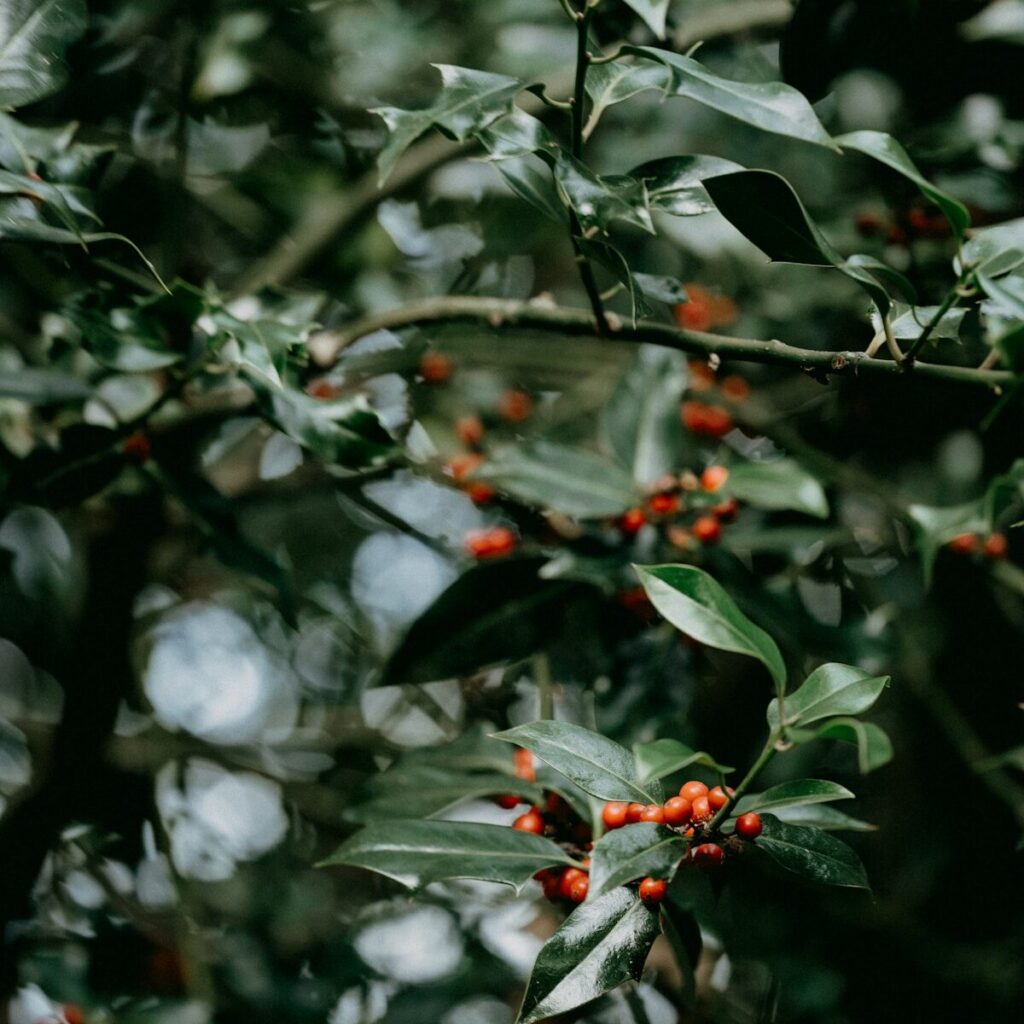
The holly tree has an unmistakable presence in the winter landscape. Its glossy green leaves remain when many other plants have retreated for the season, while clusters of bright red berries stand out against the darker months.
For witches and Pagans, that contrast gives holly a rich symbolic language: protection, resilience, vitality, boundaries, and the persistence of life through winter.
Holly is also closely associated with Yuletide and winter traditions, making it a natural addition to seasonal altars, wreaths, charms, and rituals. In modern witchcraft, holly can be used to represent the strength required to move through difficult seasons while keeping a spark of vitality alive.
If you work with dried botanical materials in your practice, Moonfall Metaphysical may also carry dried holly and holly berries for decorative and symbolic spellwork.
A note about safety: Holly is not an edible magical herb. Holly leaves and berries can be harmful if swallowed, and the sharp leaf spines can cause physical injury. Keep holly away from children and pets, and do not use holly in teas, tinctures, edible offerings, or other preparations intended for consumption.
Magical Properties of Holly
Holly has accumulated a wide range of magical associations through folklore, seasonal traditions, and modern witchcraft. Some correspondences are rooted in the plant’s physical characteristics, while others come from contemporary magical traditions.
Protection
Protection is perhaps the most recognizable magical association of holly.
The sharp points of its leaves naturally lend themselves to symbolism surrounding boundaries and defense. A holly bush planted near a home can also form an imposing natural barrier, giving the plant an obvious connection to guarding and protection.
In witchcraft, holly can be incorporated into protective charms, seasonal altar arrangements, wreaths, or spellwork intended to strengthen personal boundaries.
A small piece of holly placed near a doorway can serve as a symbolic reminder that your home is a protected space.
Strength and Resilience
Holly remains green through winter, making it an especially fitting symbol of endurance.
While surrounding plants may lose their leaves and retreat into dormancy, holly remains vibrant. This makes it useful in magical work focused on perseverance, courage, resilience, and maintaining your strength through difficult periods.
Holly can be particularly fitting for rituals performed during the darker months when the landscape itself seems to emphasize endurance.
Vitality
The combination of evergreen leaves and bright berries gives holly a strong association with life continuing through winter.
Its green leaves can represent persistence, while the red berries bring warmth, vitality, and the returning promise of life.
For this reason, holly can be incorporated into workings centered on motivation, vitality, renewal, and keeping your inner fire alive.
Love and Devotion
Holly’s brilliant red berries have also contributed to associations with love, passion, devotion, and the warmth of human connection during winter.
Rather than limiting this symbolism to romantic love, holly can be used to represent loyalty and enduring bonds.
It may therefore have a place in spells or rituals concerning committed relationships, friendship, family, or maintaining affection through periods of separation.
Luck and Prosperity
Holly’s ability to remain green during the coldest part of the year has made it a natural symbol of good fortune and continued abundance.
In seasonal witchcraft, holly can be incorporated into workings for prosperity, household blessings, and carrying good fortune safely through the darker part of the year.
Boundaries
The prickly leaves of holly offer another useful magical metaphor: knowing where your boundaries begin.
Holly can be a fitting plant for workings involving personal protection, saying no, strengthening emotional boundaries, or creating a clearer division between your own energy and that of others.
Its symbolism doesn’t need to be aggressive. Sometimes protection simply means deciding what you will and will not allow into your space.
Renewal and Rebirth
Holly’s winter greenery also connects it with cycles of renewal.
The Winter Solstice marks a turning point in the solar year. The nights have reached their longest point, and daylight begins its gradual return.
Holly’s continued presence during this transition makes it a natural symbol for enduring darkness while preparing for renewal.
It can therefore be incorporated into rituals involving endings, beginnings, transformation, and the return of hope.
Divination
Some modern practitioners associate holly with intuition, omens, and divination. Its winter symbolism can make it particularly appropriate for readings focused on endurance, boundaries, hidden strength, and what is beginning to emerge beneath the surface.
A sprig of holly on a divination altar can also serve as a seasonal marker, connecting a reading with the energy of winter.
Holly and Winter Witchcraft
One of the reasons holly has such a strong place in winter magic is its refusal to disappear.
Many deciduous trees stand bare through the cold months, while holly remains green. Its berries add another striking contrast, appearing almost like small sparks of colour against a winter landscape.
This makes holly particularly well suited to magic involving:
- Protection
- Resilience
- Courage
- Vitality
- Household blessings
- Boundaries
- Luck
- Love and devotion
- Renewal
- Winter and Yule rituals
Holly can be especially meaningful when used alongside other evergreen plants in seasonal workings. Rather than representing winter as an absence of life, evergreen plants offer another perspective: life has changed form, but it has not disappeared.
The Holly King and the Oak King
The Holly King and Oak King are familiar figures within many modern Pagan and Wiccan traditions.
The story describes two opposing yet complementary forces associated with the waxing and waning year. The Oak King represents the growing strength of the Sun, while the Holly King represents the declining solar light and the darker half of the year.
At the solstices, their positions shift as the balance of daylight changes.
In many modern interpretations, the Oak King is associated with the period from the Winter Solstice toward the Summer Solstice, when daylight increases. The Holly King is associated with the period from the Summer Solstice toward the Winter Solstice, when darkness gradually increases.
At Yule, the Oak King defeats the Holly King and the light begins its return. At Litha, the Holly King defeats the Oak King as the days begin to shorten.
The story creates a poetic way of understanding the turning of the Wheel of the Year.
Is the Holly King an Ancient Celtic God?
This is where the history becomes important.
The Holly King and Oak King are sometimes described online as an ancient Celtic myth, but there is no solid historical evidence for an ancient Celtic tradition featuring these two kings battling for control of the year.
The pairing as it is understood today is part of modern Pagan and Wiccan mythology and developed through twentieth-century occult and Pagan literature. Robert Graves’ The White Goddess, published in 1948, played an important role in shaping the tree symbolism later associated with the Holly King and Oak King. The concept was subsequently developed within modern Wiccan practice.
That doesn’t make the symbolism meaningless.
Modern witchcraft contains many living traditions that have developed through a mixture of folklore, mythology, literature, ritual practice, and contemporary spirituality. The Holly King remains meaningful to many practitioners because the story gives poetic form to something we can observe every year: the changing relationship between darkness and light.
The important distinction is simply between a modern magical tradition and an ancient historical belief.
Holly at Yule
Holly has become strongly associated with winter celebrations, particularly Christmas and Yuletide traditions in Britain and other parts of Europe.
Its evergreen foliage makes it an obvious winter decoration, while its red berries provide a striking contrast during a season when much of the landscape is dormant.
For modern witches, holly can be incorporated into Yule practices as a symbol of:
Protection — guarding the home during the darker months.
Endurance — remaining strong through winter.
Vitality — carrying the spark of life through darkness.
The returning Sun — recognizing the turning point of the Winter Solstice.
Renewal — making space for the new cycle ahead.
A sprig of holly can therefore become more than seasonal decoration. It can serve as a physical reminder of the themes you want to carry with you through winter.
Holly Correspondences
Correspondences vary between magical traditions, so there isn’t one universal correspondence system for holly. The following associations are commonly useful within modern witchcraft.
| Correspondence | Holly |
|---|---|
| Botanical Name | Ilex aquifolium |
| Element | Fire |
| Planetary Associations | Mars, Saturn |
| Colours | Green, red |
| Season | Winter |
| Magical Uses | Protection, strength, vitality, boundaries, luck, love, renewal |
| Sabbat Associations | Yule / Winter Solstice |
| Symbolism | Endurance, protection, resilience, life through winter |
| Common Names | English Holly, European Holly, Hulver, Holm |
The associations of Fire, Mars, Saturn, and other correspondences vary between sources and magical traditions. Treat correspondence tables as a framework for your own practice rather than a fixed set of universal rules.
Holly Berries in Witchcraft
The bright red berries are one of holly’s most recognizable features and carry much of the plant’s winter symbolism.
In magical practice, holly berries can be used symbolically in:
Seasonal Altar Decor
A few berries can represent vitality, protection, and the persistence of life during the winter months.
They can be particularly striking on a Yule altar alongside candles, evergreen branches, pinecones, or other seasonal objects.
Protection Work
Because the protective symbolism of holly extends to the berries, they may be incorporated into symbolic charms and protective displays.
Love and Devotion
The vibrant red colour of the berries can represent passion, affection, loyalty, and enduring connection.
Offerings
Some practitioners use non-edible botanical materials symbolically in offerings. If holly is used in this way, consider the destination of the offering carefully and make sure it cannot be accessed by children or animals.
Spell Jars and Charms
Dried holly berries can be included in decorative spellwork when their symbolic meaning fits the intention.
Because holly berries are toxic if swallowed, they should never be included in anything that could be mistaken for food, tea, or an edible offering.
Holly Wood in Witchcraft
Holly wood has long held a place in magical folklore and modern witchcraft.
Its association with protection and resilience makes it particularly appropriate for tools intended to support defensive or boundary-setting magic.
Holly Wands
Holly is sometimes chosen for wands because of its associations with strength, protection, and magical power.
A holly wand can be used as a symbolic tool for directing energy during ritual, spellwork, meditation, or seasonal ceremonies.
Charms and Talismans
Small pieces of holly wood can be carved into protective charms or kept as personal talismans.
A naturally fallen piece can be especially meaningful for practitioners who prefer not to cut living trees for magical materials.
Divination Tools
Holly wood can also be used to create symbolic divination tools such as pendulums, casting pieces, or other carved objects.
The meaning comes from the relationship between the practitioner, the material, and the intention behind the tool.
Altar Objects
A small piece of holly wood can simply rest on an altar as a representation of protection, endurance, or winter.
Not every magical object needs to be actively used in a spell. Sometimes its purpose is to hold symbolism within a sacred space.
A Simple Holly Protection Ritual
You don’t need an elaborate ceremony to work with holly.
For a simple winter protection ritual, use a small fallen holly leaf or twig if one is available safely and legally.
Place the holly on your altar beside a candle. Take a few moments to think about what you want protected: your home, your peace, your relationships, your personal boundaries, or something else important to you.
Light the candle and hold your attention on the qualities you associate with holly.
Imagine its evergreen leaves remaining strong through winter.
Then speak a short intention such as:
May my home remain protected.
May my boundaries remain strong.
May I carry my strength through the darkness.
May what belongs in my life remain, and what does not belong find its way elsewhere.
Sit quietly for a few moments before extinguishing the candle.
The holly can remain on your altar throughout the winter season as a physical reminder of the protection you called into the space.
Working Safely With Holly
Holly is beautiful, but it is not an herb for internal use.
The leaves have sharp spines that can puncture or irritate the mouth and skin, and ingestion can cause nausea, vomiting, diarrhea, and abdominal pain. Holly berries can also cause gastrointestinal symptoms when swallowed.
Holly is also considered toxic to dogs, cats, and horses by the ASPCA.
For magical purposes:
- Do not make holly tea.
- Do not consume holly berries or leaves.
- Do not use holly in edible offerings.
- Keep berries and dried plant material away from children and pets.
- Wear gloves when handling branches with sharp leaves.
- Keep fallen berries and leaves cleaned up if pets or young children have access to the area.
- Use symbolic or decorative alternatives if there is any concern about accidental ingestion.
- If harvesting your own holly, follow local regulations and avoid damaging living plants unnecessarily.
If you suspect that a person or animal has swallowed holly, contact an appropriate poison control service, medical professional, or veterinarian for guidance.
Holly Folklore and Winter Traditions
Holly’s winter symbolism isn’t difficult to understand when you look at the plant itself.
It stays green when many other plants appear dormant. Its leaves are tough and prickly, and its berries provide vivid colour during a season dominated by bare branches and muted landscapes.
These characteristics helped make evergreen plants important features of winter decoration and folklore.
Holly became associated with bringing greenery indoors during the winter season, and its presence around the home carried associations with protection, good fortune, and the continuation of life.
For modern practitioners, these older seasonal associations can sit comfortably alongside contemporary magical practice.
A holly wreath on the door can become a protective symbol.
A holly sprig on the altar can represent resilience.
Its winter greenery can remind us that dormancy is not the same thing as death.
And its red berries can represent the warmth and vitality that remain even in the darkest part of the year.
Holly, Darkness, and the Return of Light
Perhaps the most compelling magical lesson of holly is found in the season when it is most visible.
Winter can feel still, quiet, and dark. Yet holly remains green.
That makes it a fitting plant for magical work surrounding the Winter Solstice and the turning of the year. It represents the ability to hold onto vitality during difficult seasons and to recognize that cycles continue even when change is difficult to see.
For witches working with the Wheel of the Year, holly can therefore become a powerful symbol of the dark half of the cycle—not as something evil or to be feared, but as a necessary period of rest, reflection, protection, and preparation.
The darkness eventually turns.
The light returns.
And the holly remains green while we wait.
Closing Thoughts
Holly brings together some of the most enduring themes in winter witchcraft: protection, strength, resilience, vitality, boundaries, and renewal.
Its evergreen leaves offer a reminder of life continuing through the cold season, while its bright berries add colour and warmth to the winter landscape. Whether you place a sprig on your altar, work with fallen wood, incorporate holly into a protective charm, or simply admire it growing outdoors, the plant offers plenty of symbolism for seasonal magical practice.
Holly doesn’t need to be ancient, mysterious, or complicated to have a place in your craft.
Sometimes the magic is simply in noticing what survives the winter.